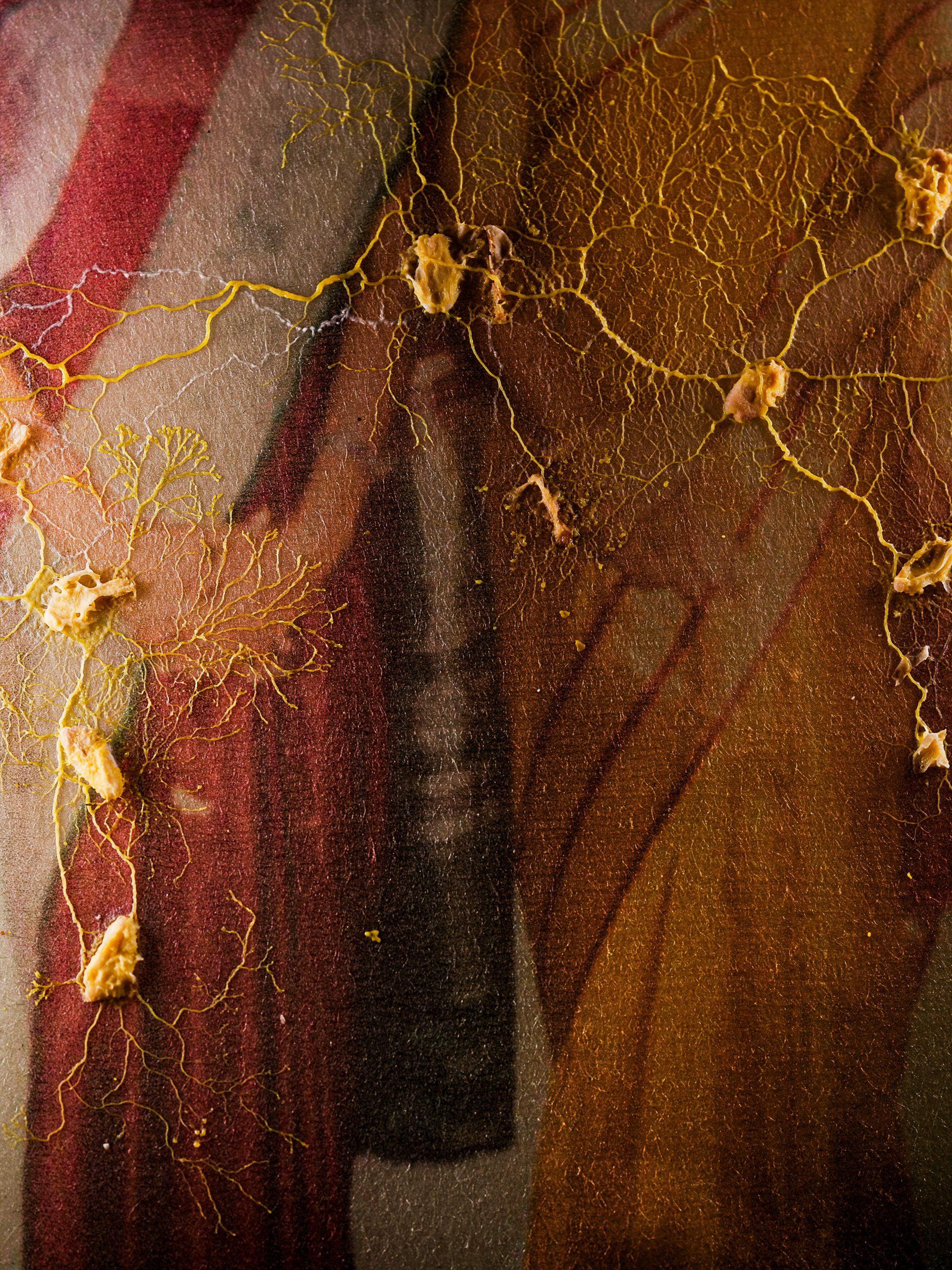
“The longer I stared at the image of my mother and my maternal grandmother’s archive, I could feel the power registered in these images. These images portray my mother as a daughter, a mother, a wife, sometimes a friend, but none of them showed who these women were in the world, how they showed up, what [they do].”
This desire to reimagine the family archive led Kanishka Puri — a New York City-based Indian visual artist exploring kinship and knowledge through interspecies collaboration and ecological entanglement — to her two-year research project, Everything Reminds Me of You. Working at the intersection of photography and bio art, Kanishka collaborates with slime mold, also known as Physarum polycephalum (an acellular organism belonging to the class Myxomycetes that exhibits remarkable problem-solving abilities despite lacking a brain or nervous system) to create web-like structures resembling bodily arteries over photographs from her matrilineal archive, bringing them to life. “By focusing so closely on these fragments, the women in the photographs begin to transform,” Kanishka says.
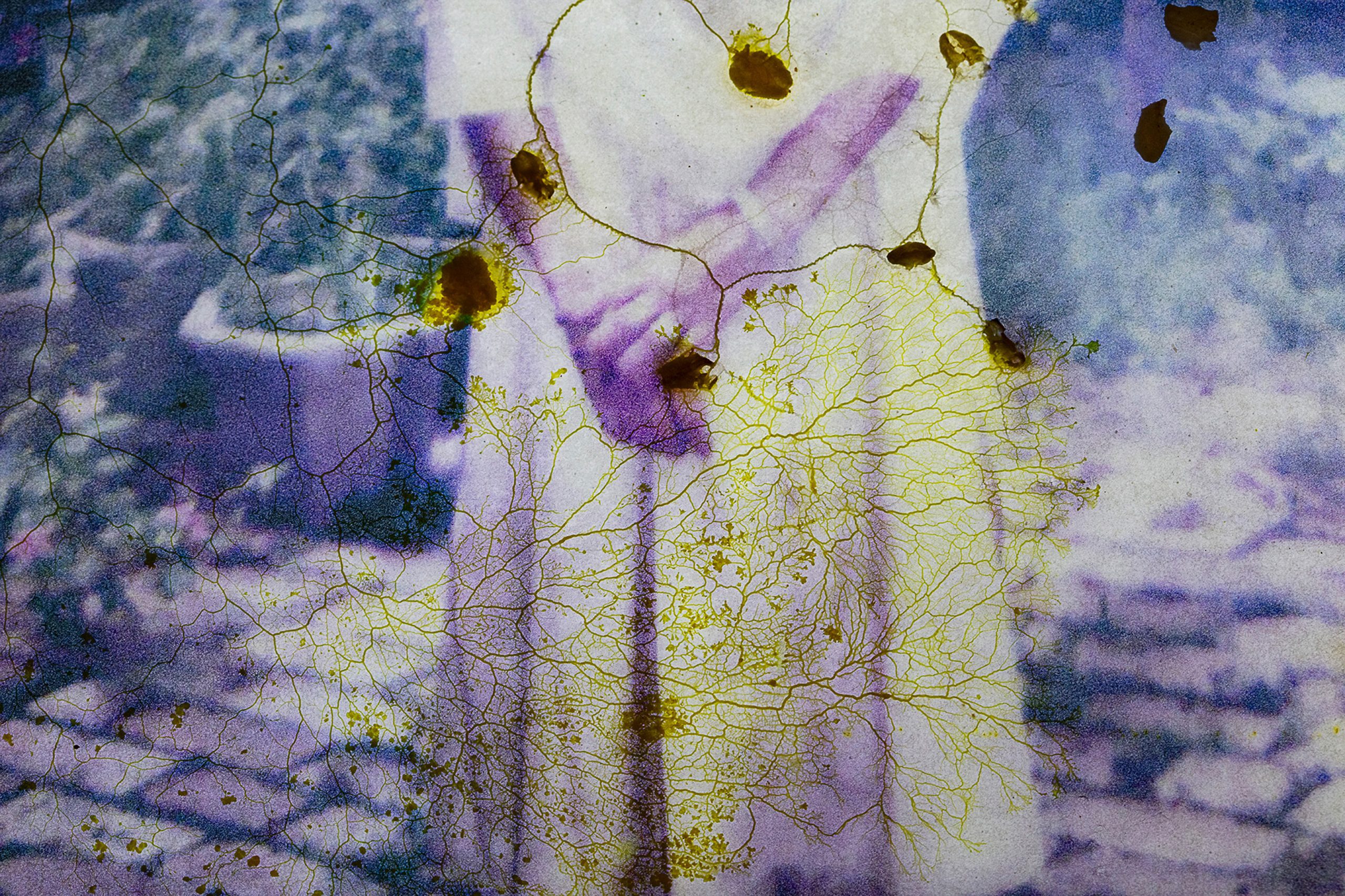
Explorer, slime mold growth on Puri’s mother’s photograph
The process is slow and unpredictable; an individual image creation can take anywhere between two to three weeks as the slime mold gradually grows and forms new pathways across the photograph. In doing so, she creates a new image, one in which these plasmodial, vein-like networks become so embedded within the photograph that it is difficult to tell whether one is looking at the organism itself or at a pattern that is already a part of the image.
The making of these living photographs requires a different kind of artistic labour, one shaped by patience, uncertainty, and care. Working with a living organism comes with its own challenges and moments of disappointment, as the growth of slime mold cannot always be predicted or controlled. Kanishka’s background in engineering sometimes comes in handy during this process. She carefully maintains the conditions needed for the organism to grow, sterilising the environment, monitoring temperature, and keeping the slime mold away from light that can interrupt its development. Her wardrobe transforms into a makeshift laboratory.
“The slime mold is constantly moving, merging, and splitting, and that temporality became central to the work,” Kanishka explains. Through this process, her role extends beyond that of an image-maker to that of a caregiver, tending to a living photograph.
The idea of collaborating with another species emerged from Kanishka’s interest in invisible labour and alternative forms of intelligence. “I started thinking about collaboration with another species, and it immediately made me think about invisible labour within domestic households in India, particularly the labour performed by women,” she says. “It opened up the possibility that another living organism could become an active participant in making meaning rather than simply becoming the subject of representation.” The anatomical nature of the photographs, with their repeating hands and bodily fragments, also points toward the invisibility of women’s labour within patriarchal systems.
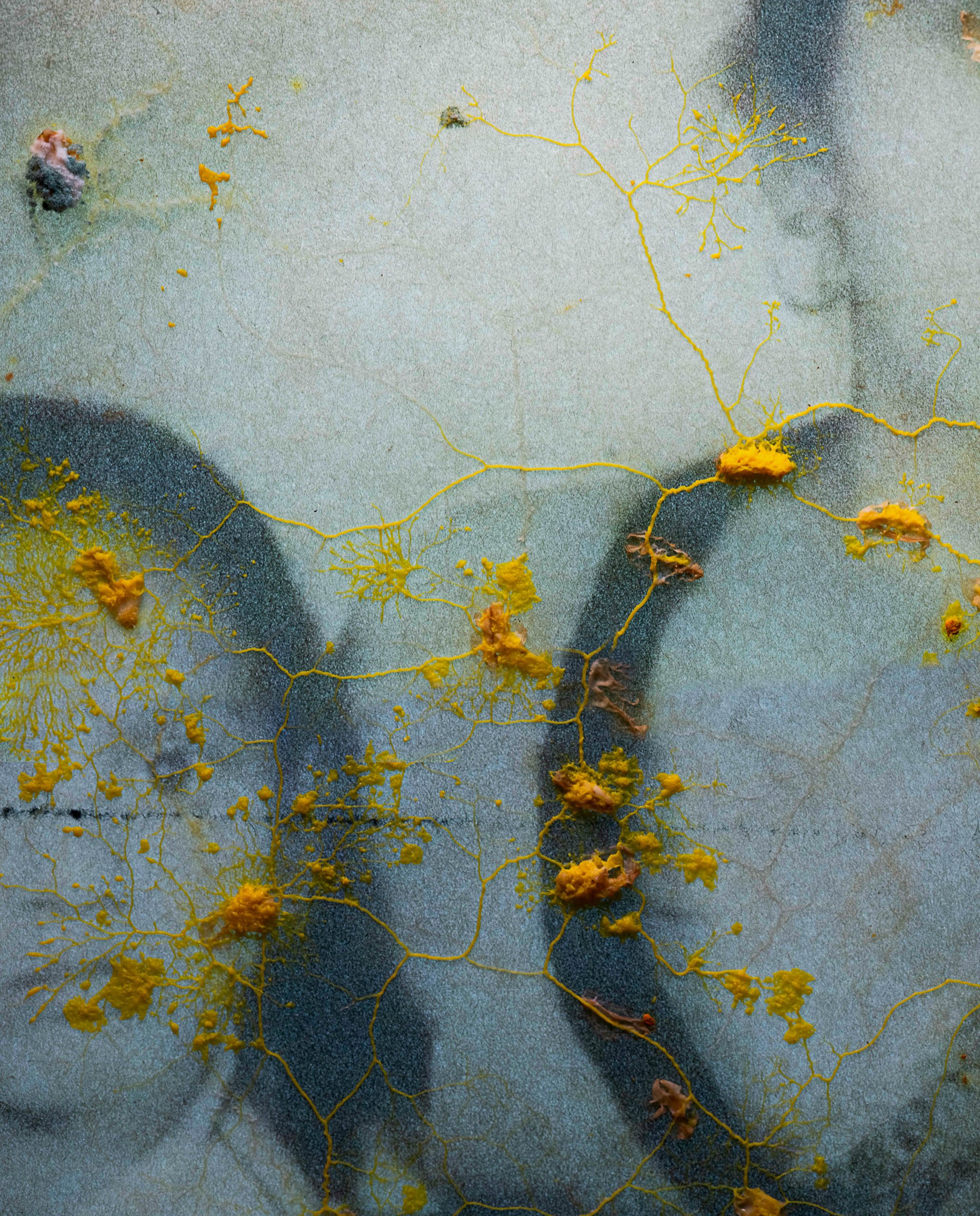
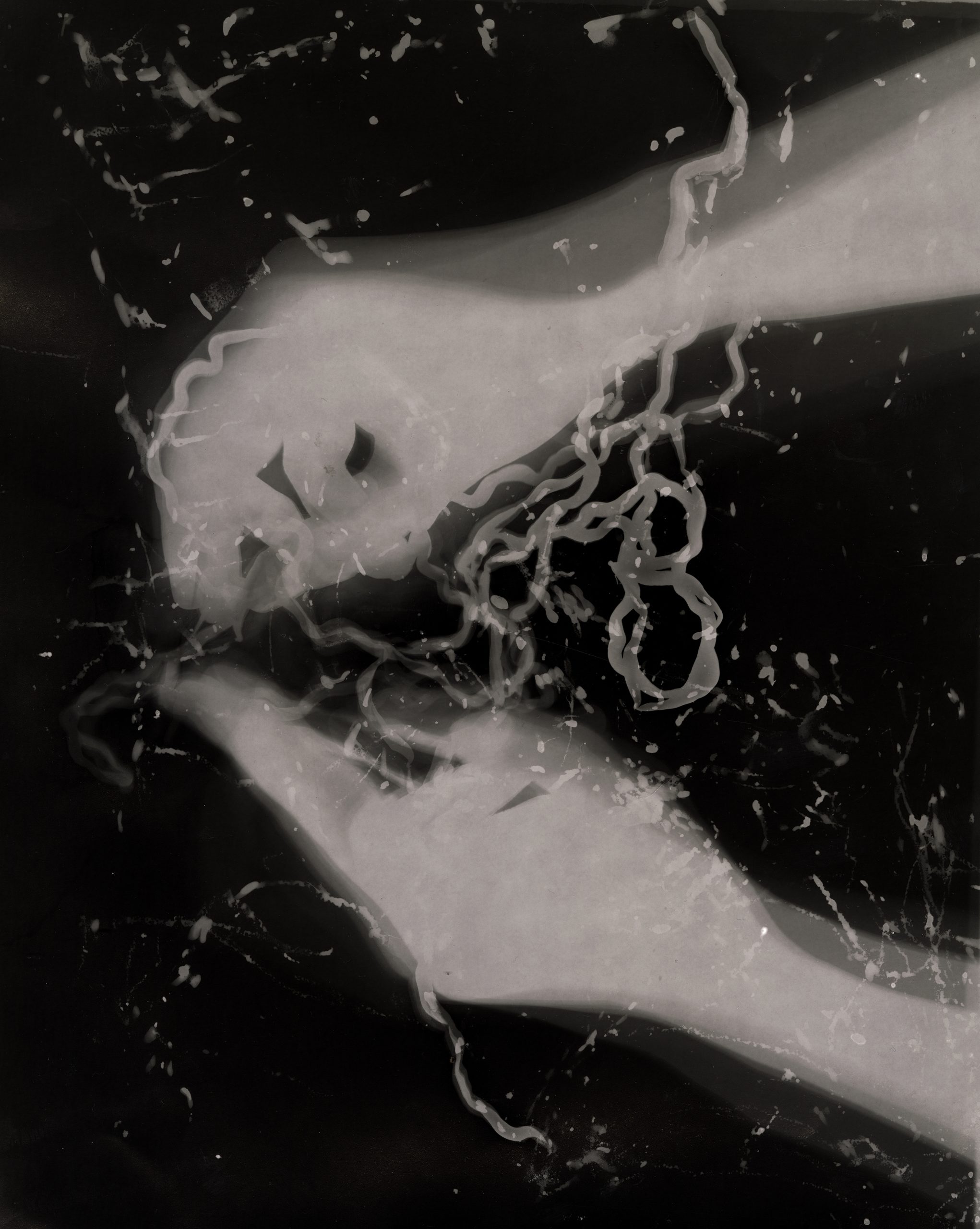
(L-R) Welcome Foreigner; Weaving Legacy (photogram of weaving algae bio yarn) Art
“This gives me an opportunity to connect with the non-human world and find solidarity with other forms of life. Their destruction and exploitation under patriarchal structures mirrors the ways certain forms of labour, especially women’s labour, are made invisible. Through this collaboration, I am interested in imagining different ways of being together across human and non-human worlds.”
For Kanishka, these women are not simply figures preserved in an archive; they are active forces shaping communal futures. “My aim has been to produce counternarratives depicting their far-sightedness,” she says. “These women were not naive or bodies without agency. Instead they were far-sighted. Each one networked and set up a collective stage for the next generation and that’s how I am here.”
Reading Kanishka’s bio, I found myself lingering on its final line — “When not writing or making or talking to her mother, she is taking care of her slime molds.” It is an ending that quietly reveals the foundations of her practice. The pairing of these two acts, speaking with her mother and tending to another living organism, suggests that both are forms of care, attention, and collaboration. It made me wonder about the place her mother occupies in her work: Not simply as a source of inspiration, but perhaps as a guide, a collaborator, or even the person with whom the work begins.
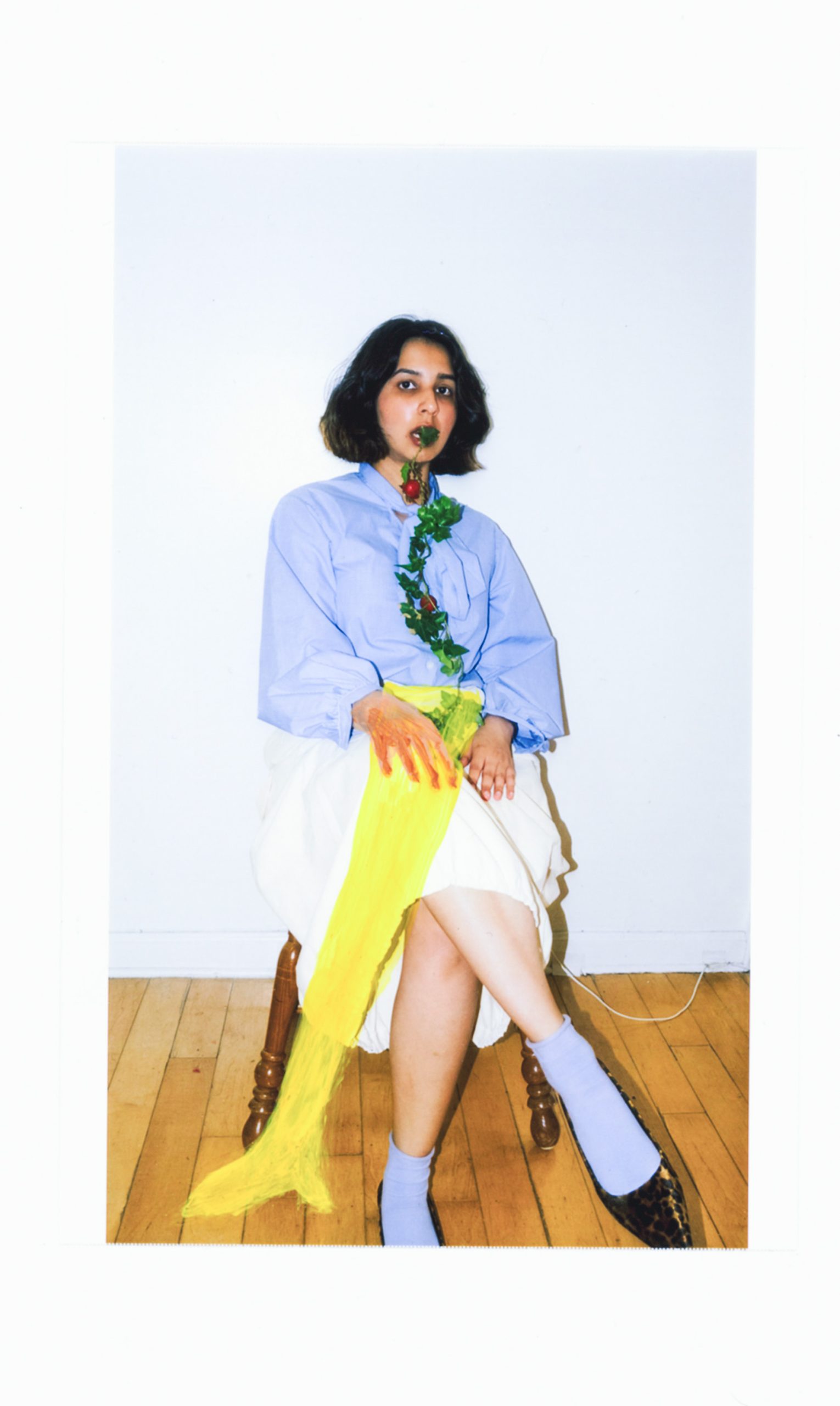
NYC-based Kanishka Puri’s practice brings forth transformed memories of the women in her family
Now living in the United States, Kanishka describes her conversations with her mother as one of the most important parts of her day. “As much as she is my muse and my guide, I think our relationship has become something much more reciprocal. These phone calls are mutually transformative.”
In this way, the family archive becomes more than a record of the past. It becomes a space where memory can be reimagined, where feminist histories can continue to unfold, and where the women who came before Kanishka remain present in the future she is building. For Kanishka, reframing history requires confronting the patriarchal gaze that has been internalized across generations, shaping how women have been taught to see their mothers, grandmothers, and themselves. Her work lingers in that complexity rather than seeking easy resolution. Rather than treating the archive as a closed record of the past, she presents it as something unfinished, capable of growth and revision. In doing so, her work suggests that the histories inherited by women need not be accepted as they are. They can be expanded, rewritten, and reimagined to make space for lives, relationships, and forms of knowledge that have too often remained unseen.
Words by Julia Ferry
Featured image: Kanishka Puri, Martian Mothers, slime mold growth on photograph (3 weeks)