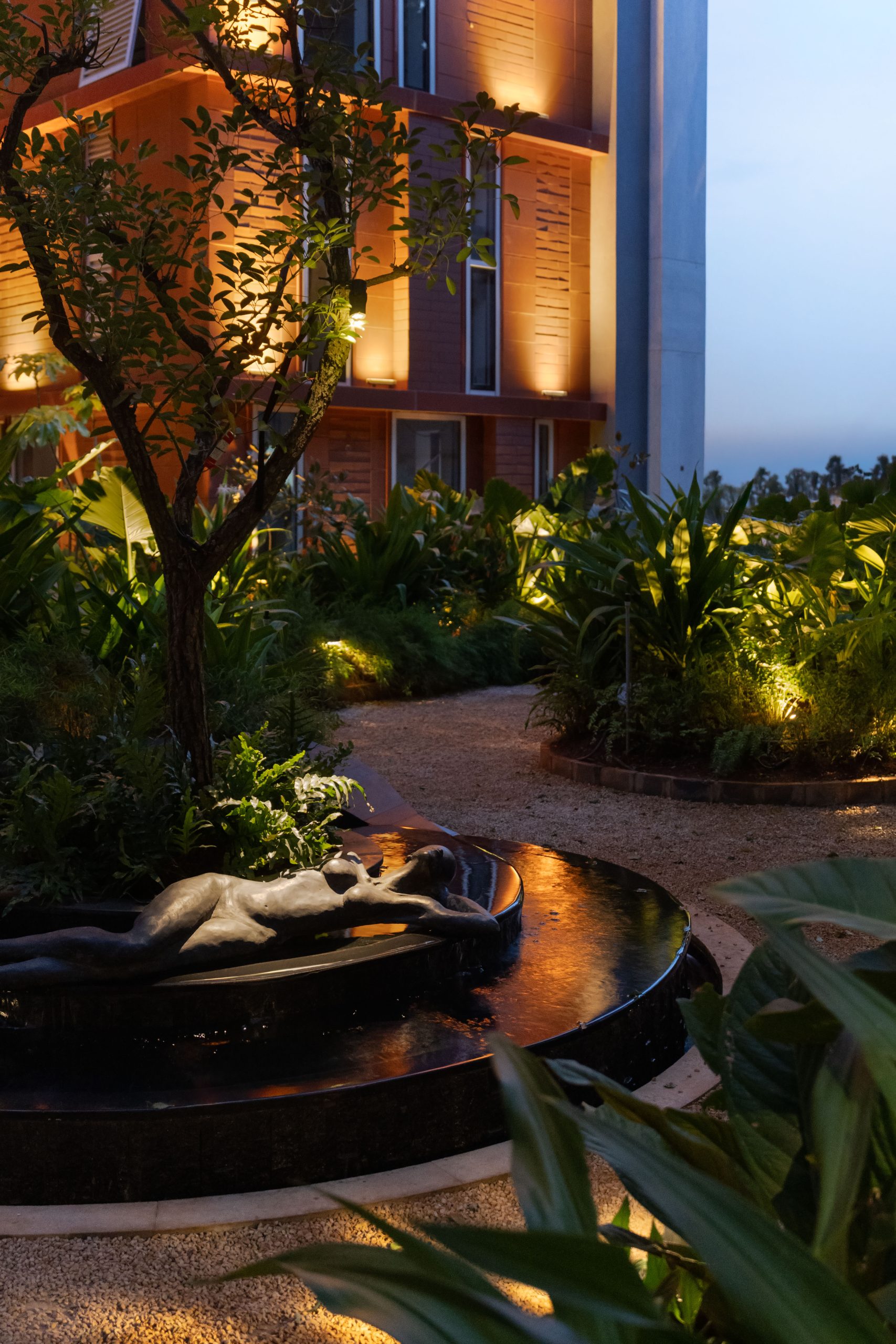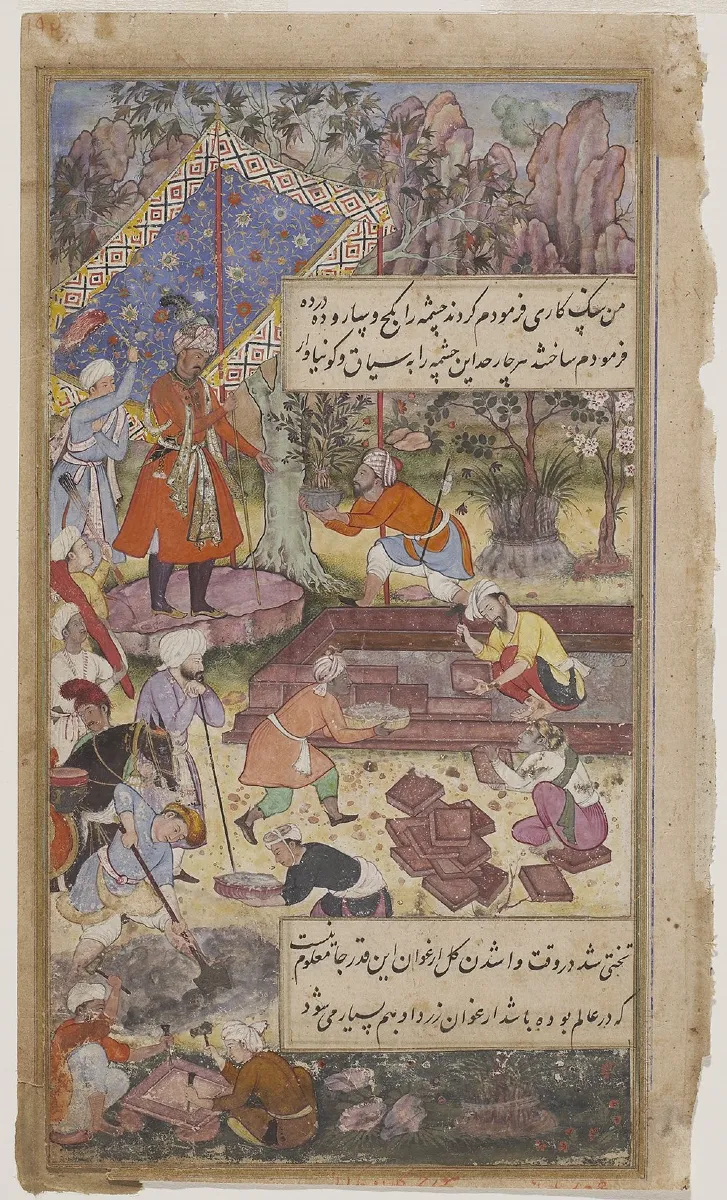
What is an enduring image of paradise? Many of us in the subcontinent have seen a rare sense of beauty when stepping into an orchard or lingering over contemporary photographs and painted works of the Mughal gardens of Delhi, Kashmir, and Lahore. In India (and large parts of Pakistan), a lasting image of Gulistan, Jannat-e-Arzi, or Firdous — paradise on Earth — is often associated with orchards featuring running fountains, bespoke terraces, flowering trees, and jewel-toned, fruit-bearing landscapes.
My initial appeal towards these natural, often meticulously designed gardens as familiar spaces emerged from experiencing both the physical sites and their representations in paintings that bring them to life. I began to wonder: Who among us has ever refrained from daydreaming about such romanticised places and musing about their stories? I realised that the idea of paradise, so deeply embedded in the artistic and architectural imagination of Mughal India and so long a fascination of our subcontinent, was itself shaped by a deep history of longing.
Long before the Mughals came to India, Persianate and Islamic garden traditions had cultivated a precise idea of art, luxury, and sovereignty in the rulers’ minds. The Charbagh (near Samarkand and Persia), marked with its fourfold division, ornamental trees, cypresses, poplars, and access to copious running water, first emerged from garden traditions that long predated the Mughals. Much of what we appreciate as part of our opulent heritage spaces was not always part of our nations’ histories. As evidenced in the Babur Nama, Babur’s explicit complaints about Indian landscapes revealed the gap between the environment he encountered in Hindostan and his ideal garden: Ordered establishments with geometric architecture, streamlined water channels, and enclosed orchards with densely planted trees and carefully arranged flower beds. The Mughal Charbagh: Paradise Gardens on Earth (c. 1590) visually articulated the divine symbolism of the four divisions, where the miniature painting created a magnificent bridge between spiritual scripture and physical architecture, essentially showcasing the meeting of Heaven and Earth.
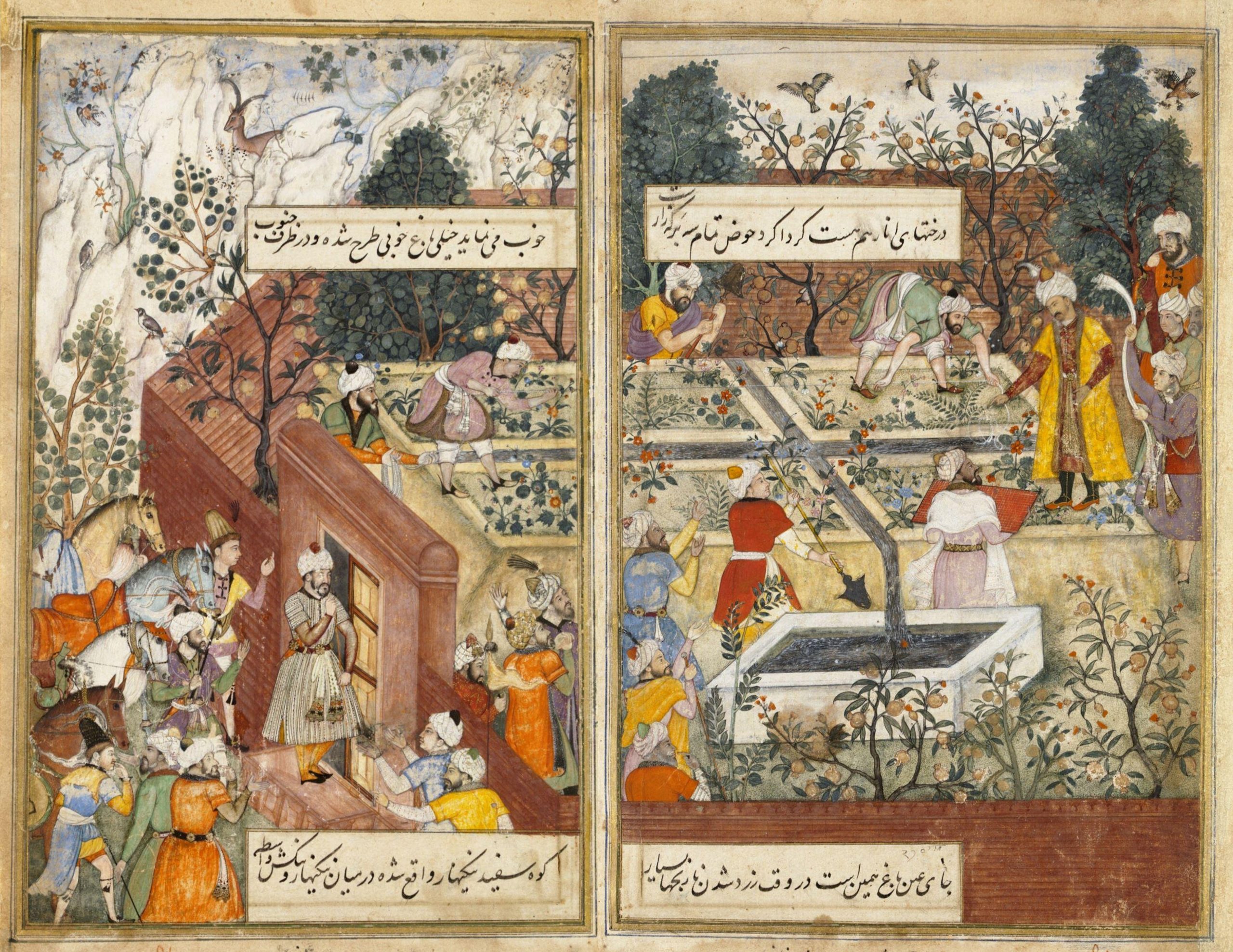
Babur supervising laying out of Kabul garden by Bishndas and Nanha, opaque watercolour on paper, 1590. Courtesy, Victoria and Albert Museum
Emperor Babur’s yearning for the landscapes of the Ferghana Valley, Kabul, and Central Asia — particularly Timurid Central Asian lands — with lush gardens, fruit orchards, fresh streams, and mountains first led to the creation of gardens as physical paradisal spaces. The Mughals took to constructing green estates with large walled compounds, massive baths and pools, water channels, and grand pavilions. But paintings — particularly miniatures — transformed these spaces into a way of preserving memory, dominion, and imperial lifestyle beyond the display of beauty. Babur Supervising the Laying Out of the Garden of Fidelity — the Bagh-i-Wafa (c. 1590), by Bishandas and Nanha — directly illustrated that ideal. A diptych composition spanning two separate sheets of paper, the painting demonstrated the mathematical precision it took to grid a four-part paradisal land into a rugged landscape.
When emperors such as Babur, Akbar, and Jahangir commissioned Mughal miniature paintings, they often presented a constructed image of gardens and courtly life, since many were not painted as immediate records or from direct observation; rather, they were reconstructed from written memoirs and accounts. They also hinted at a paradox. While the paintings constructed an image of Mughal splendour as meticulous and elegant, they sometimes obscured the labour and inequality of power in making these gardens.
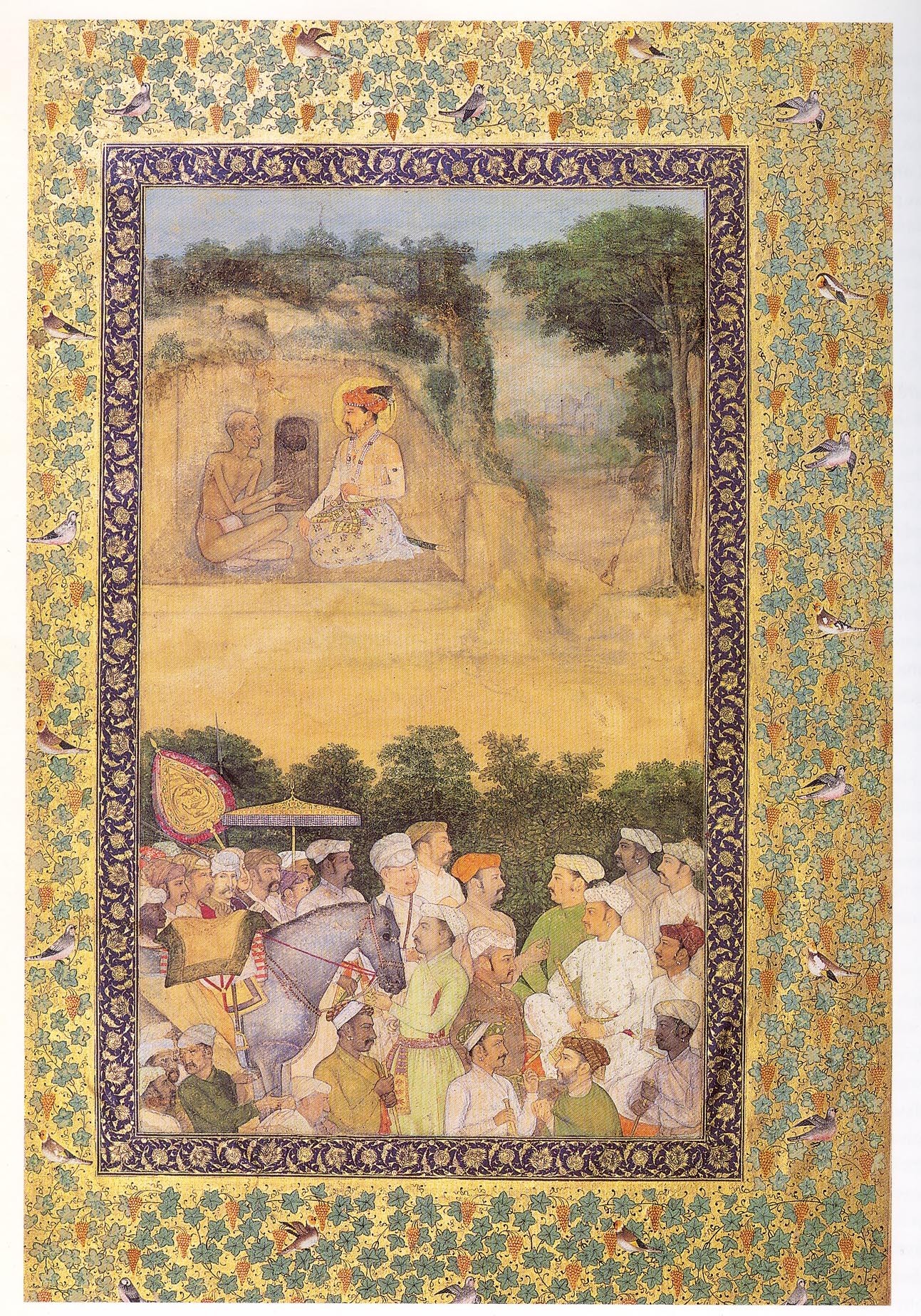
Jahangir in Conversation with Gosain Jadrup, opaque watercolour and gold on paper, 1620
The garden, then, existed in two forms at once: A physical landscape carefully constructed on the earth, and an imagined landscape (preserved and even renovated) through painting. Perhaps this duality is one of the reasons we continue to be drawn to these spaces today. The Mughal gardens remain spaces marked by memories; their representations in written sources induce a deep look at culture, and, simultaneously, the museums allow us to encounter these paradisal landscapes through paintings and other inherited works as intellectual nourishment and visual pleasure.
But these gardens, since historical times, were not merely decorative backdrops; they quickly went from being artistic compositions into much-needed political expressions of imperial imagination, especially rendered through artwork. In pre-partition India, these gardens slowly became as much acts of transformation and assertions of power as they were expressions of nostalgia for old lands. Babur, for instance, constantly sought to make Hindostan into a Central Asian example of art, architecture, and possessions in his pursuit of royal fervour, abundance, and cultural identity. An area around his garden in present-day Delhi was even locally identified as “Kabul”, for example, and the large Mughal garden complex beside the Yamuna became a place of relaxation, highlighting watercourses, kitchens, barracks, and stables with an abundance of fruit and other foods.
Babur thus described his gardens, foremost, as spaces of leisure — places reserved for spending time with companions, drinking, feasting, and enjoying the surroundings, while conducting ceremonies and hunting excursions. The Tuzuk-i-Jahangiri — or the Jahangirnama — even indicated a fascination with and a lamentation for succulent fruits, which made the rulers see these gardens as sites of horticultural experimentation. The rulers commanded the prudent cultivation of hybrid varieties of citrons, oranges, bananas, and sugarcane, as well as melons, peaches, grapes, and pomegranates that were native to distant, wistful lands. The garden became a repository of geographic memory. The mango, thoroughly native to the Hindostan landscape, occupied an even more sophisticated place in the geography of gardens. Abul Fazl brazenly mentioned in the Akbar Nama how the perfumed fruit was unrivalled in colour, scent, and taste, and in Women Enjoying the River at the Forest’s Edge (c. 1765), in the style of Hunhar II, mango trees heavily laden with fruit dappled across rivers and neighbouring landscapes. The gardens later started functioning as administrative and diplomatic spaces where the emperors held political gatherings, issued imperial orders, planned military campaigns, and received ambassadors and envoys, as magnificently showcased in Babur receiving Uzbek and Rajput envoys in a garden at Agra (c. 1590).
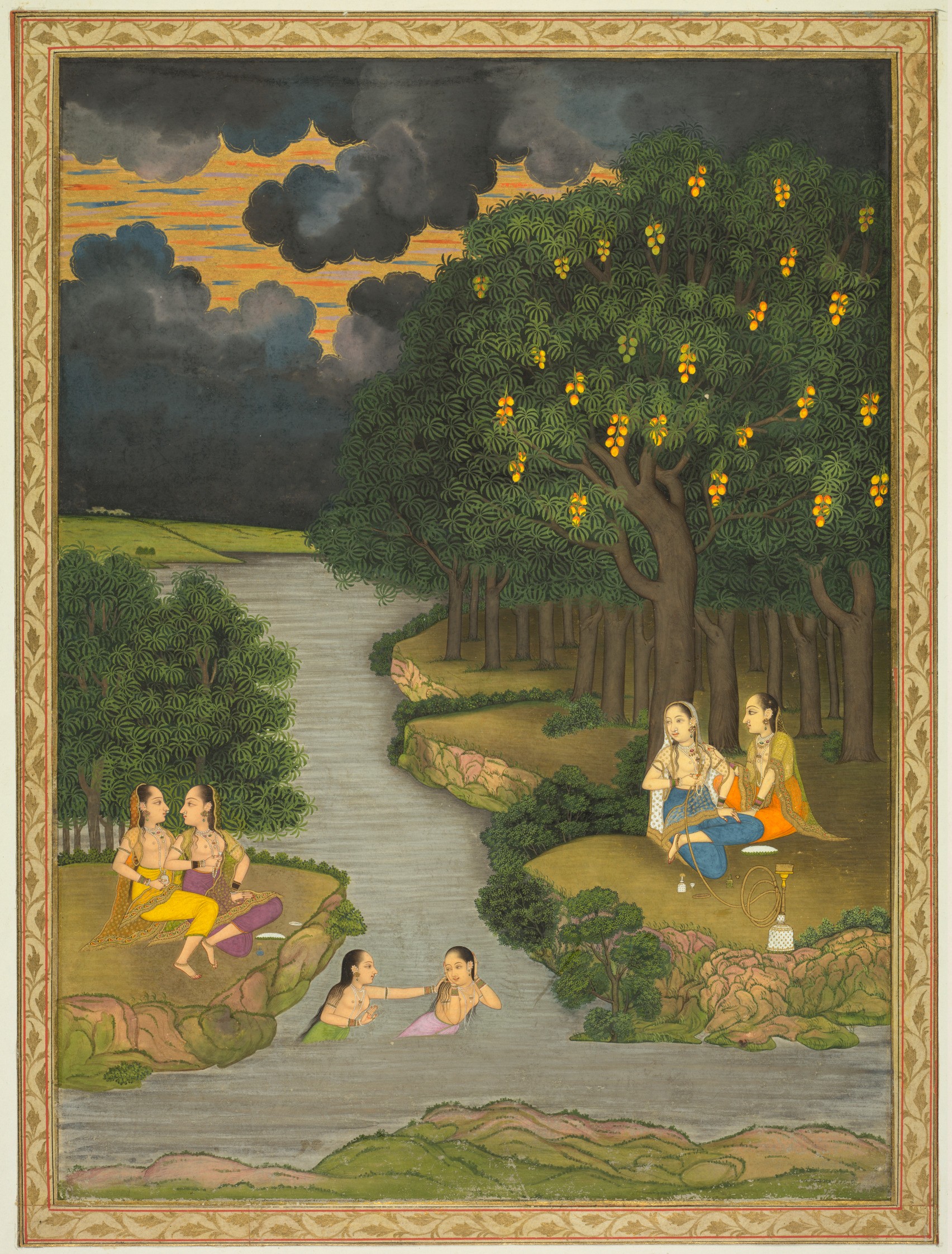
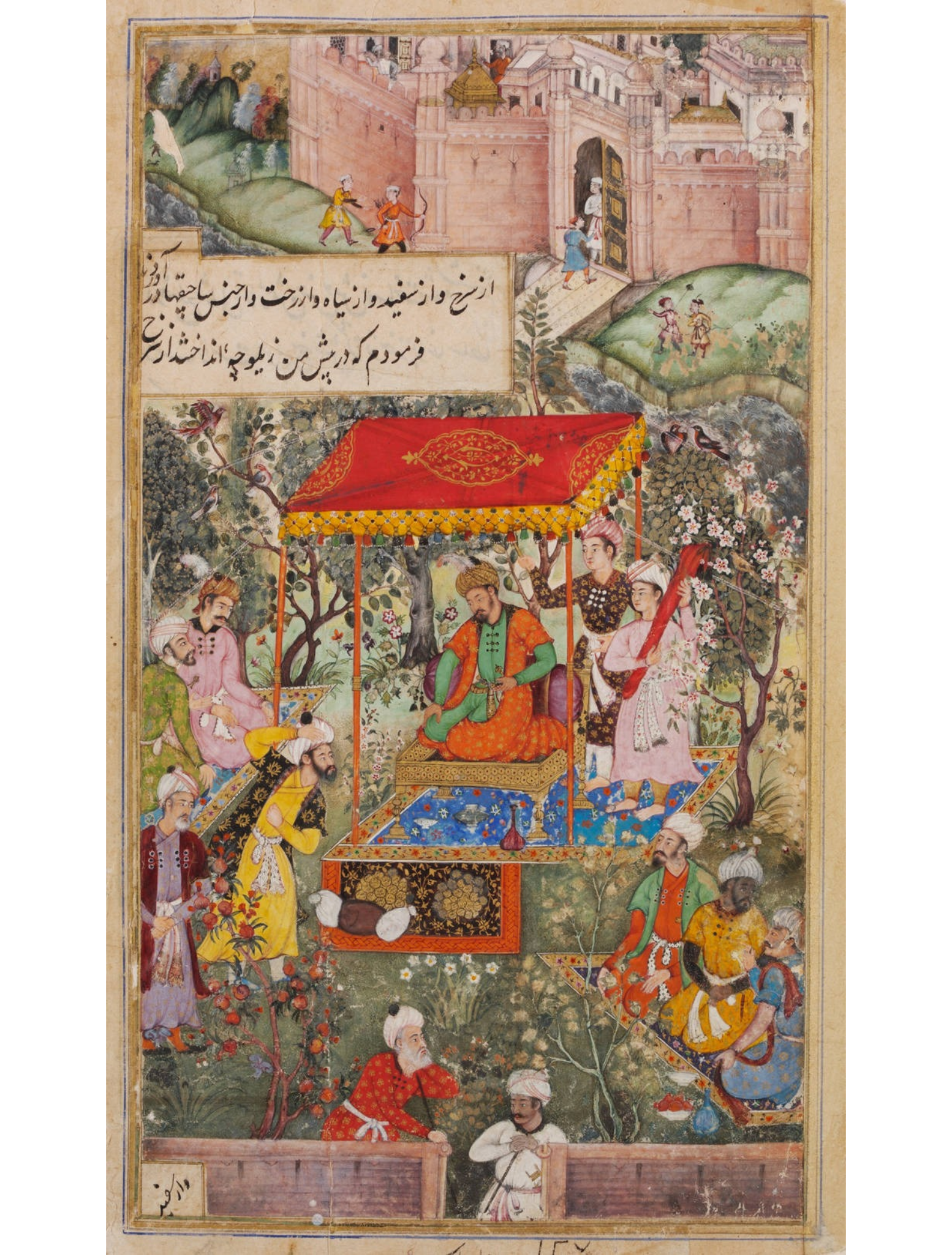
(L-R) Women Enjoying the River at the Forest’s Edge, by Hunhar II, gum tempera and gold on paper, 1765. Courtesy, The Cleveland Museum of Art; Babur Receiving Uzbek and Rajput Envoys in a Garden at Agra, by Ramdas, opaque watercolour on paper, 1590. Courtesy, Victoria and Albert Museum
The Mughal gardens have embodied the authority and opulence of an imperial regime, while enduring simultaneously as remarkable expressions of artistic craftsmanship and cultural legacy for posterity. Therefore, their appeal has never remained confined to the past, as we continue to seek out and reproduce versions of these paradisal landscapes. They exist now as heritage gardens, landscaped homes and orchards, and even the carefully composed gardens in signature hotels and premium resorts, and settings for leisure, celebration, and idealised remembrances in contemporary photography.
As the garden spaces continue to celebrate luxury in the present, they balance the beauty of cultural belonging with quixotic escape, which brings us to consider another pertinent philosophy: If Earth can feel this paradisical, what does our constant desire to recreate paradise reveal about our deepest imaginations and collective longings?
What once began as longing for distant homelands became, over time, an inheritance and then a communion between lived experience and imagined realities. Perhaps the most enthralling feature about the Mughal gardens, as especially preserved in Mughal miniatures, is how a unique image of paradise feels native to Indian identity and subcontinental heritage, making its way into some of our core ideals in contemporary times.
Words by Yukti Narang
Featured Image: Babur Orders the Spring of the Three Friends at Istalif Enclosed (1590) attributed to Basawan and Suraj Gujarati