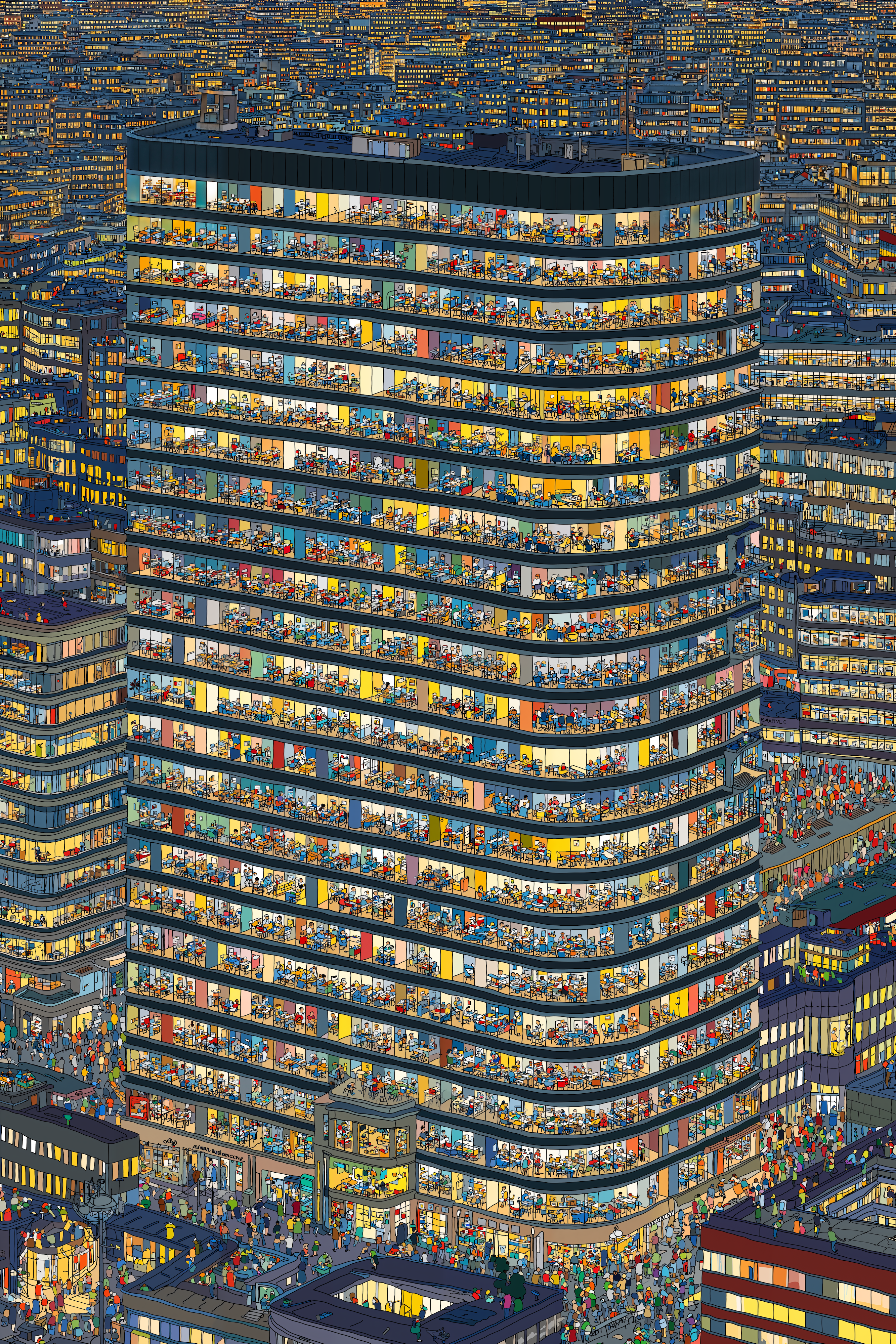
Richard Nadler is a contemporary digital artist based in Munich, Germany. His cityscapes draw your eyes in towards the multitudes that exist within the aspirational. Lives and bodies stacked atop each other in vibrant colours insist upon the individuality inside melting pots. It is remarkable to see the joy of coexistence within narrative depictions of urban spaces usually earmarked for representations of conformity. As he shares, “It started in New York when I saw the skyscrapers, and I was thinking about giving people the possibility to look inside. Like a cross-section of life there. People love to dig deeper into some scenes and get lost. And that’s why I stack them up. It’s like a story over story.”
The works show us what we ‘see’ or expect to ‘see’ when hand in hand with modernity but they also show us what Nadler ‘sees’. One does not feel alone when looking at his works. Nadler does not see people as islands, lonely in vast cosmic oceans. “It’s about how many cultures are getting together, Chinese, Indian, and American people working together in one office. Grief, sadness, love, happiness — everything happens inside. The work is observational, not judgmental.”
He uses AI to generate his artworks. But does the simplicity of this statement capture the true nature of his art? As he tells us, “People think it’s just entering a prompt and clicking on something and having an output. But it’s not that easy. I’ve come up with diffusion models where I’ve trained my own models on specific topics which takes quite a long time. The ideas come from me and AI helps me to turn the idea into an image. Your art is when you explain how something came about and it’s tied to some very personal moments and experiences. So it’s not like I’m picking anything based on search requests.”
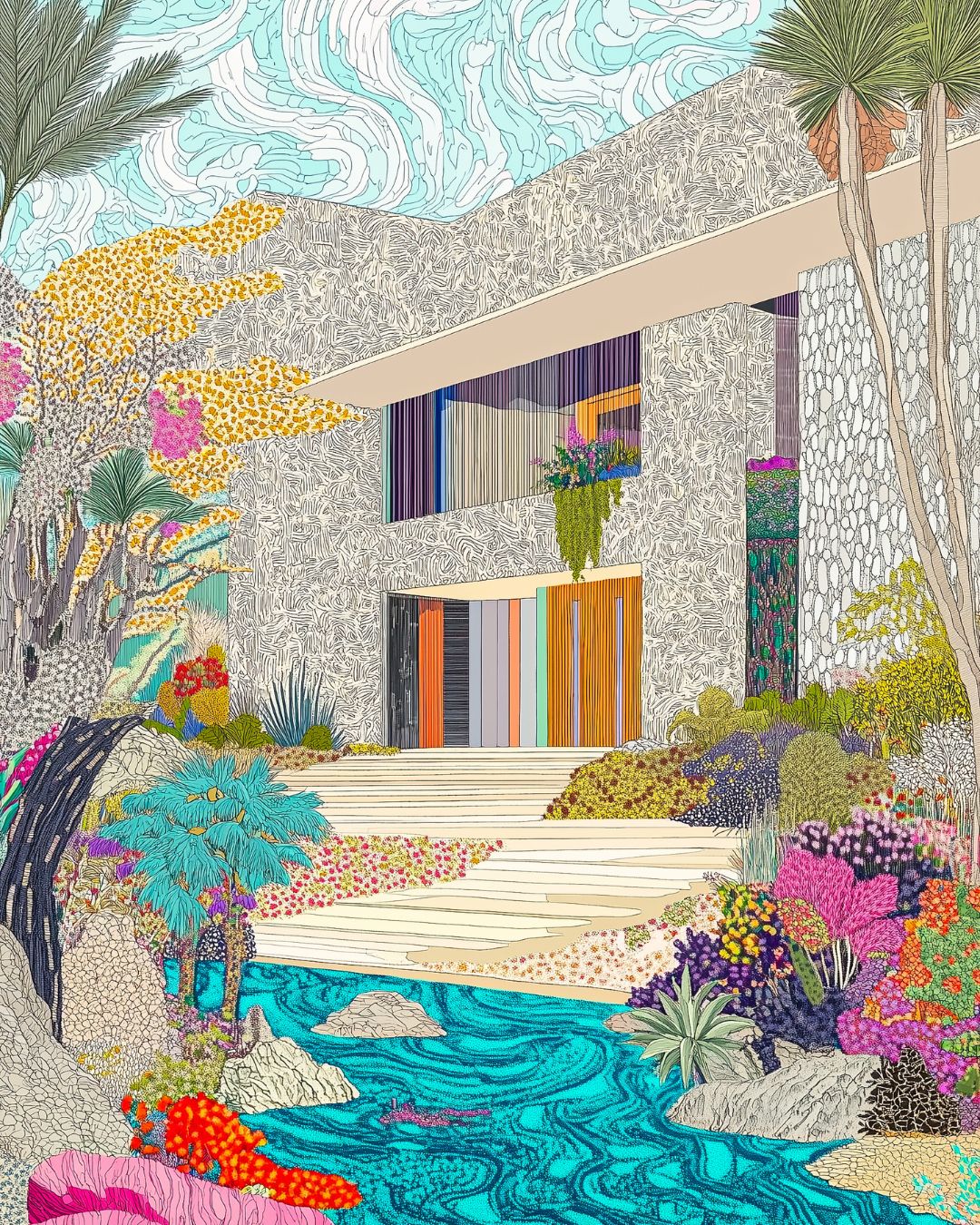
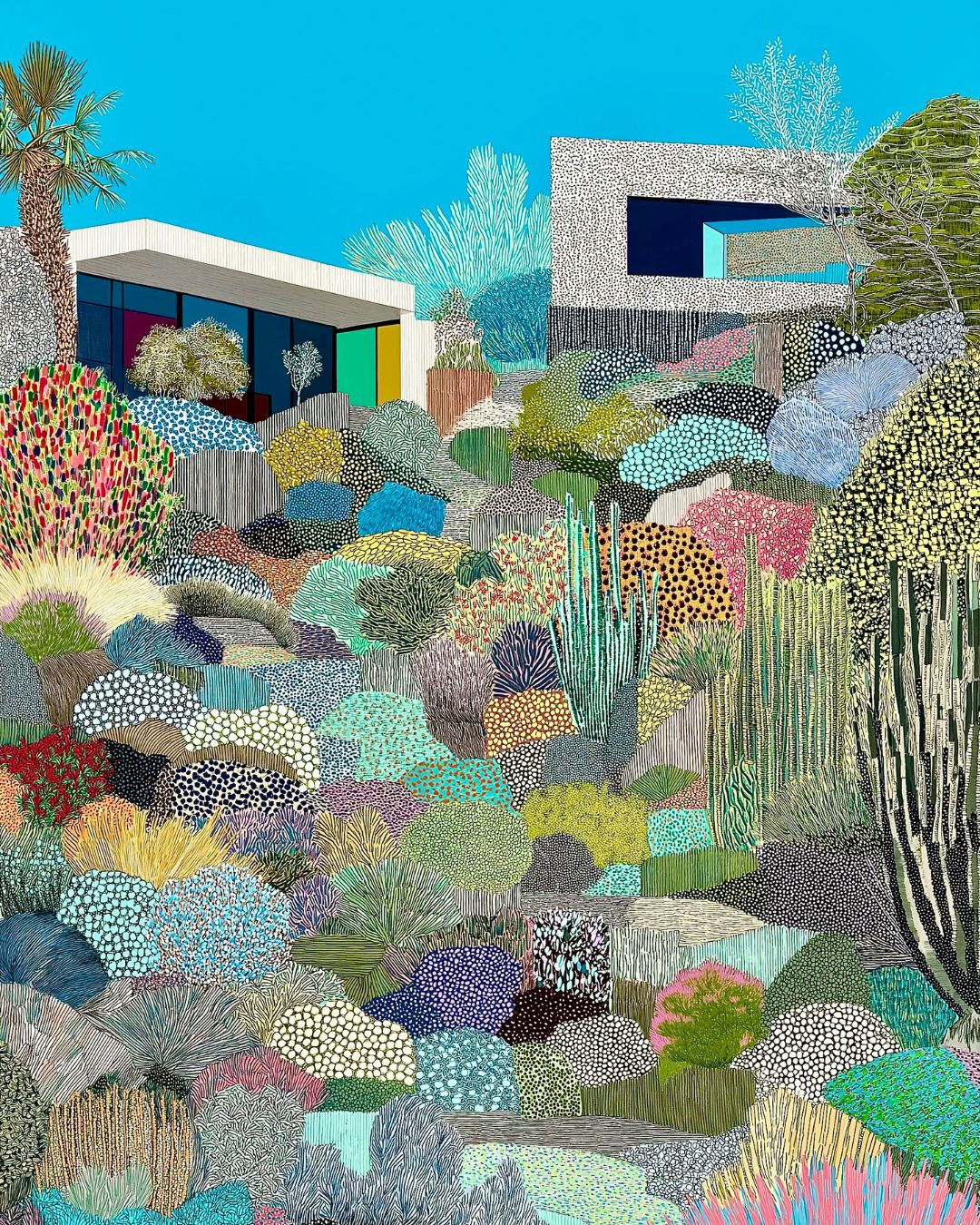
1: ArchiTextures #2 (2025) — where the built and the botanical refuse to be separated; 2: ArchiTextures #5 (2025) — the garden as protagonist
Places are vibrant with nostalgia in Nadler’s works. The art gestures towards visits with his father, from Germany to Japan, and the experience of being in Japan presents as more intense with textural and sensorial experience building in layers. He explains how he achieves that complexity, “You have ten, twenty, thirty thousand outputs to curate. It’s not like you’re sitting there and generating one artwork and boom there it is and it’s out. I guide the process and the result is shaped from iteration to iteration. For me AI is like a brush or a camera. It’s a tool to create art. What matters the most is the idea and the feeling behind the work”.
The emotional response his works evoke is anchored in his childhood memories of being in Japan, as he tells us, “Going to Sumo fights, seeing the cherry blossoms, seeing the high-speed trains, samurai, and so on, you have to imagine being a child with your fantasy, it was always kind of magical”. He has preserved that sense of awe which only childhood carries and translated it later in life into artworks that are arresting in their sense of space and magnitude.
Nadler entered art through the world of NFTs, betraying an inclination early on towards the digital. “I started on the blockchain called Tezos, and then I was curious about how people create. I exchanged with a lot of artists in Germany and then built my own framework, but I’m having a shift because I’m moving into the traditional art world”. His works have entered institutional collections, including a triptych commissioned by a Geneva bank. Nadler is now also incorporating embroidery.
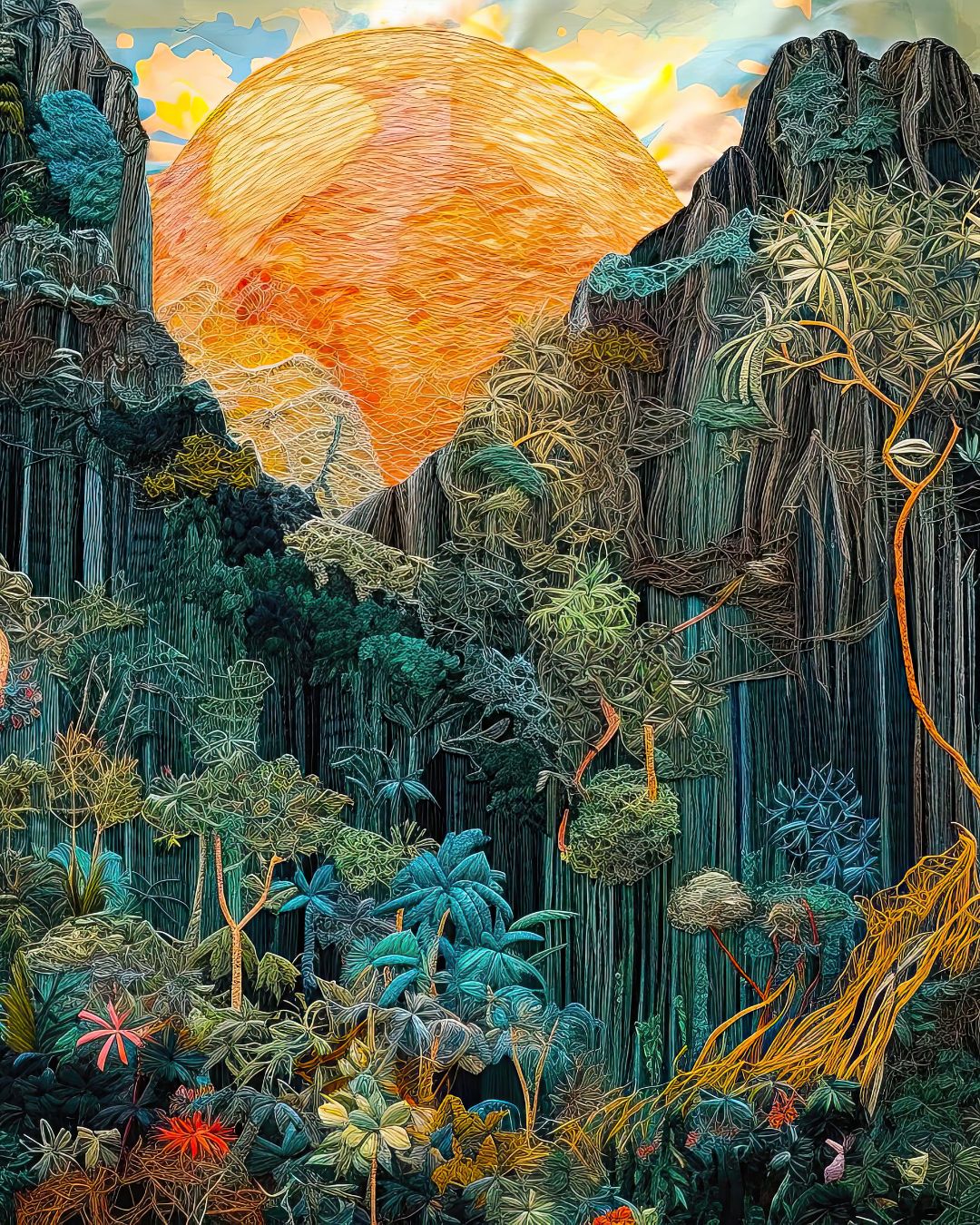
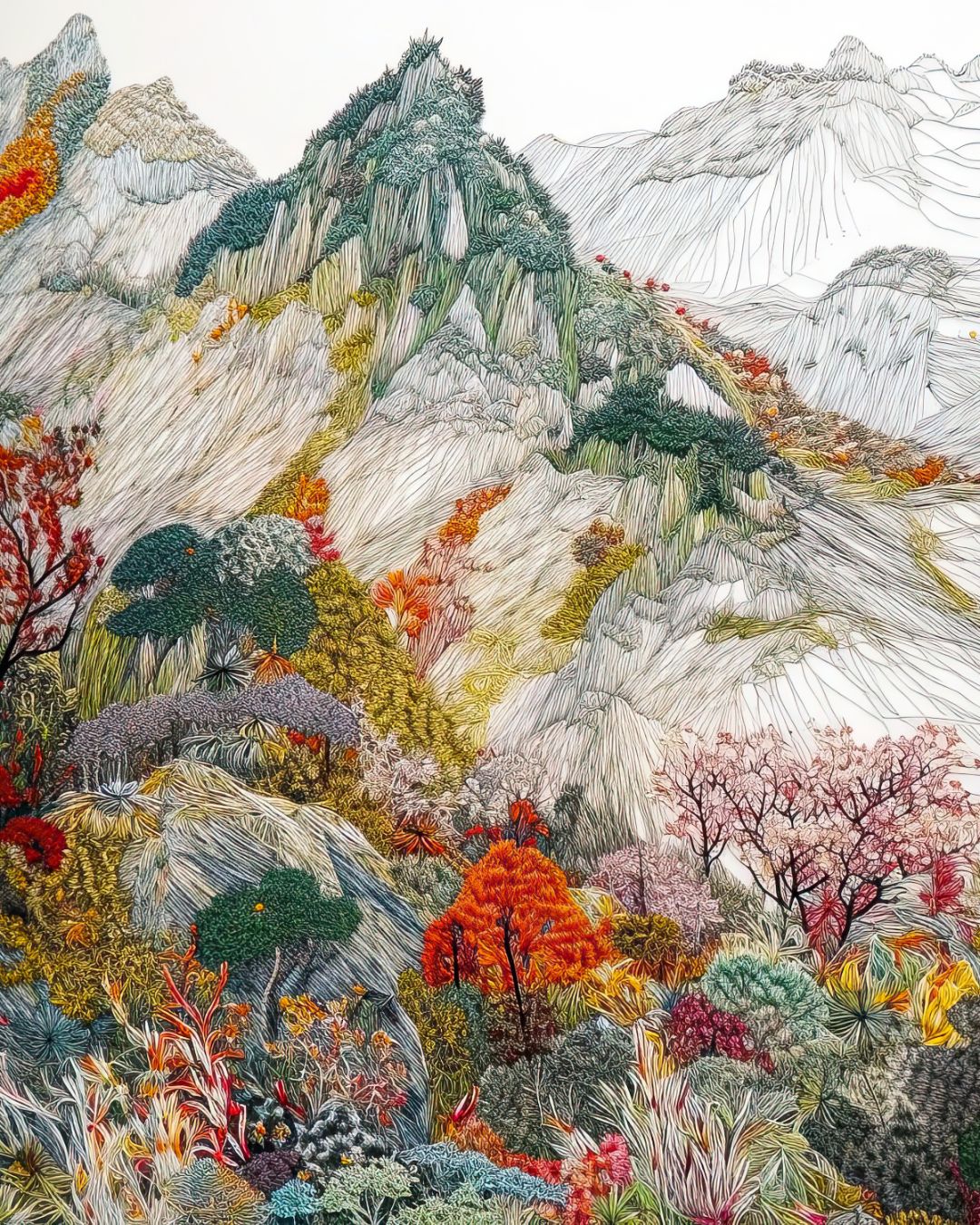
1: Izanami Islands #3 (2025) — where the sun meets the forest floor; 2: Yamabushi’s Horizons #2 (2023) — the Japan of childhood memory, held in texture and wonder
While people want an artist they favour to eventually represent one style, Nadler keeps his art open and expansive, saying, “I’m trying to catch emotions with my artworks, to bring people in an emotional state when they look at it, and ask themselves why, and why these colours, and why these scenes, and so on, and so on.”
While not unified in style, there is a unifying value sentiment throughout his perspective. Seeing beyond the surface, opening up the layers and discovering the hopeful in what might appear to be dismal, he says, “My memories of Japan are always tied to my father, who passed away when I was eighteen. The textures, the rituals, the way time is held differently there – these are layers I carry into the work without intellectualizing them. They were given to me before I could fully understand them.”
After starting at the intersection of art and finance, then moving into AI and the personal, Nadler is now coming into more traditional forms. Not presenting the varying practices as adversarial but in sync, like his view of the cross-sections of skyscrapers. In togetherness. In assistance. As he shares with us, “I now hide Easter eggs in the same Bavarian forest where my father once hid them for me, this time for my four-year-old son. That inheritance carrying forward matters in my personal narrative.”
We are not mistaken in assuming that what emerges will be exciting and humane.
Words by Ayesha Suhail
Feature Image Tower #1 (2026) by Richard Nadler