By nature, tigers are evasive beasts. The charismatic megafaunas relish in their solitude, and their stealth only contributes to the awe surrounding them. Yet, their quest for a reclusive life does not guarantee their disappearance from a larger cultural relevance. However elusive they may be, they rarely leave the mythological imagination.
In their varied territories spread across Asia, the tiger takes up many forms. In China, it stands amongst the 12 animal zodiacs as a symbol of strength and bravery; in Korea, it’s a protective spirit warding off evil. In the Himalayas, for both Tibet and Bhutan — devout Buddhist nations — the tiger is one of the Four Animals of Dignity that adorn prayer flags. A deity, a guardian, a symbol of war — the tiger is never one without wrath. But for Bhutanese artist, Zimbiri, the tiger appears in a different light. For her, it is not a beast of prey. Through her immersive artworks, the tiger becomes an unusual symbol of self-love, existing in her likeness.
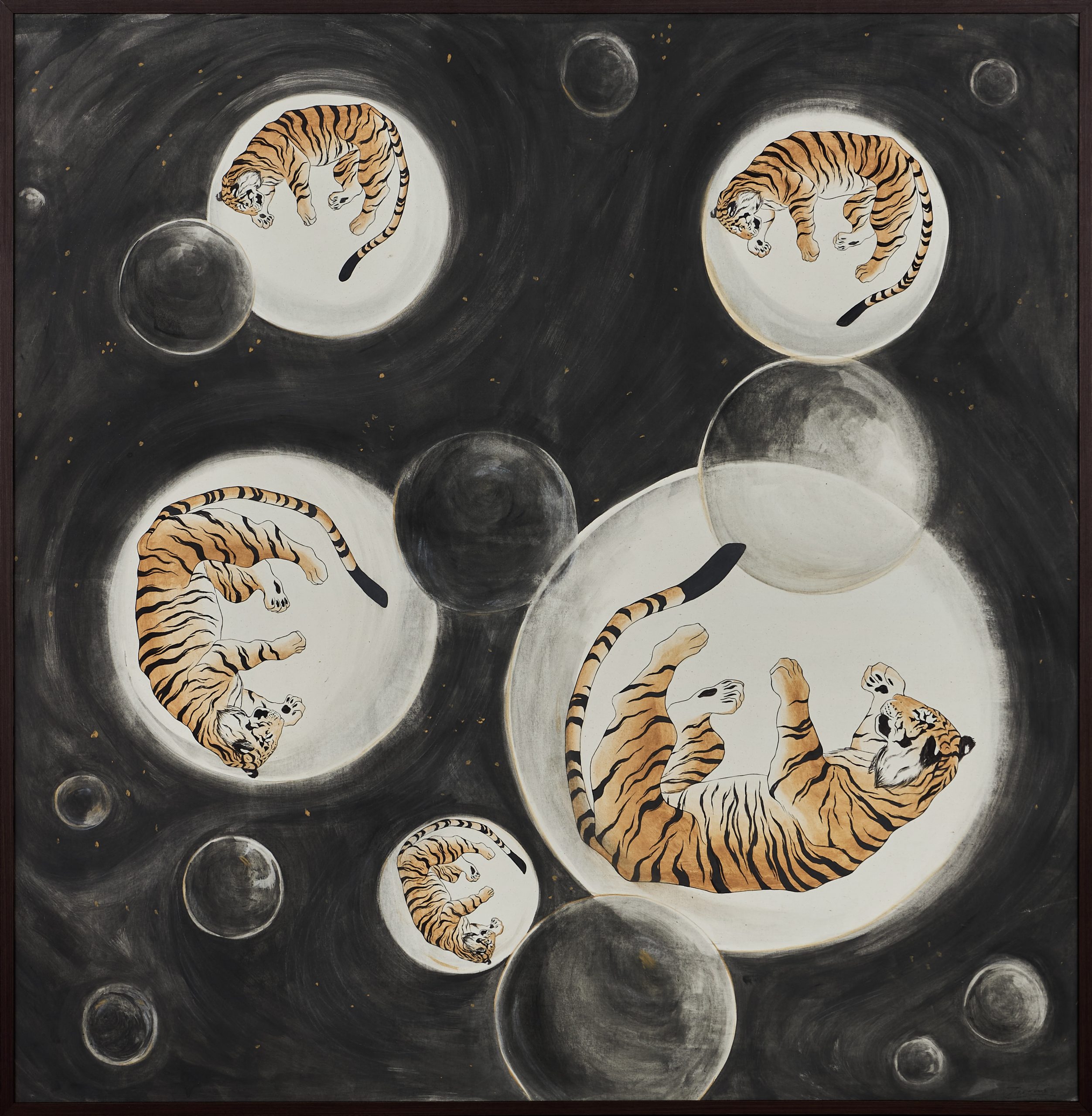
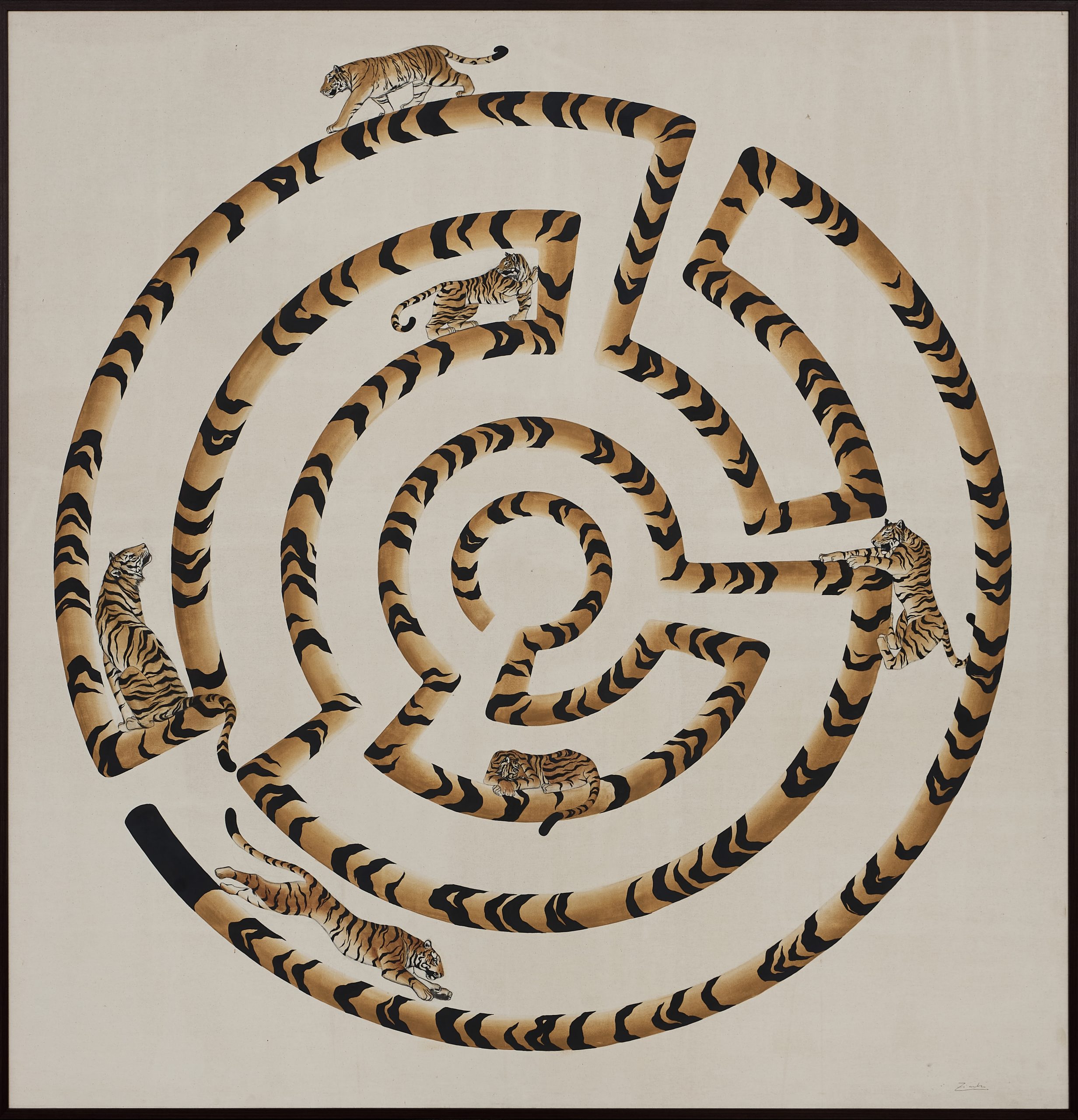
(L-R) Bubbles (float C), saa-tchen on rhay-shing, 48 x 47 inches,
2025; Maze 6B, saa-tchen on rhay-shing, 60 x 62 inches, 2026
The multidisciplinary artist has explored her relationship with the animal for a better part of her career, and this continued investigation takes form at her current solo exhibition at Nature Morte, Mumbai, titled Dear Tiger. Zimbiri can’t recall the first time she painted a tiger; she doesn’t want to. When probed as to why, she mentions the true moment of significance came later. The artist has displayed paintings centring on the animal twice at the gallery prior to her ongoing show. They’re an inseparable element of her practice — an idea she didn’t even consider until a friend presented her with the fact, leading her to ponder on it more closely for the first time in her life. Finally, she concluded that the animal was not merely an interesting image but a personal embodiment of self-love. “At that point in my life, I was learning to get better at setting boundaries, valuing my own needs, and finding a greater sense of self-worth,” she shares. Her paintings were her unconscious mind materialised, reassuring her. “When that realisation came, it was one of the most beautiful moments of my practice. It felt as though a quieter, wiser part of myself had been speaking through the work before my conscious mind had caught up.”
Her introspective paintings make for a personal show — one that centres on identity, community and, ultimately, culture. As an individual, she was focused on being a “good person”, later realising the qualities she revered needed to be extended inwards. “At the same time, I found myself drawn to qualities I associated with cats: confidence, independence, playfulness, the ability to set boundaries, and an unapologetic sense of self,” she recalls. In this process, the tiger chose her. “I have never seen the tiger as only a symbol of strength or ferocity. To me, real strength includes vulnerability, uncertainty, tenderness, and playfulness. Those qualities don’t diminish its power — they complete it,” she asserts.
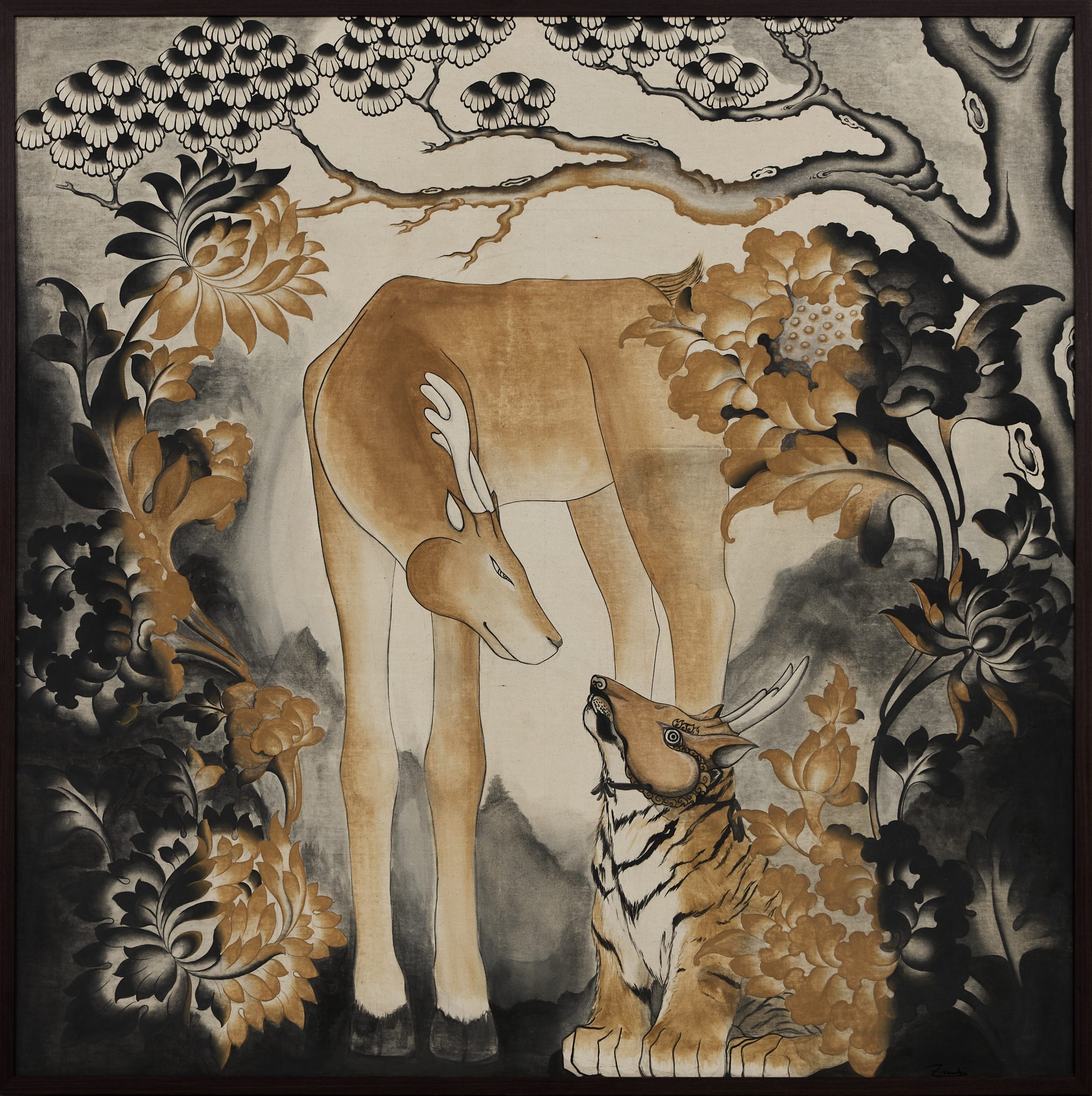
Dear Tiger 1 A, saa-tchen on rhay-shing, 36 x 36 inches, 2026
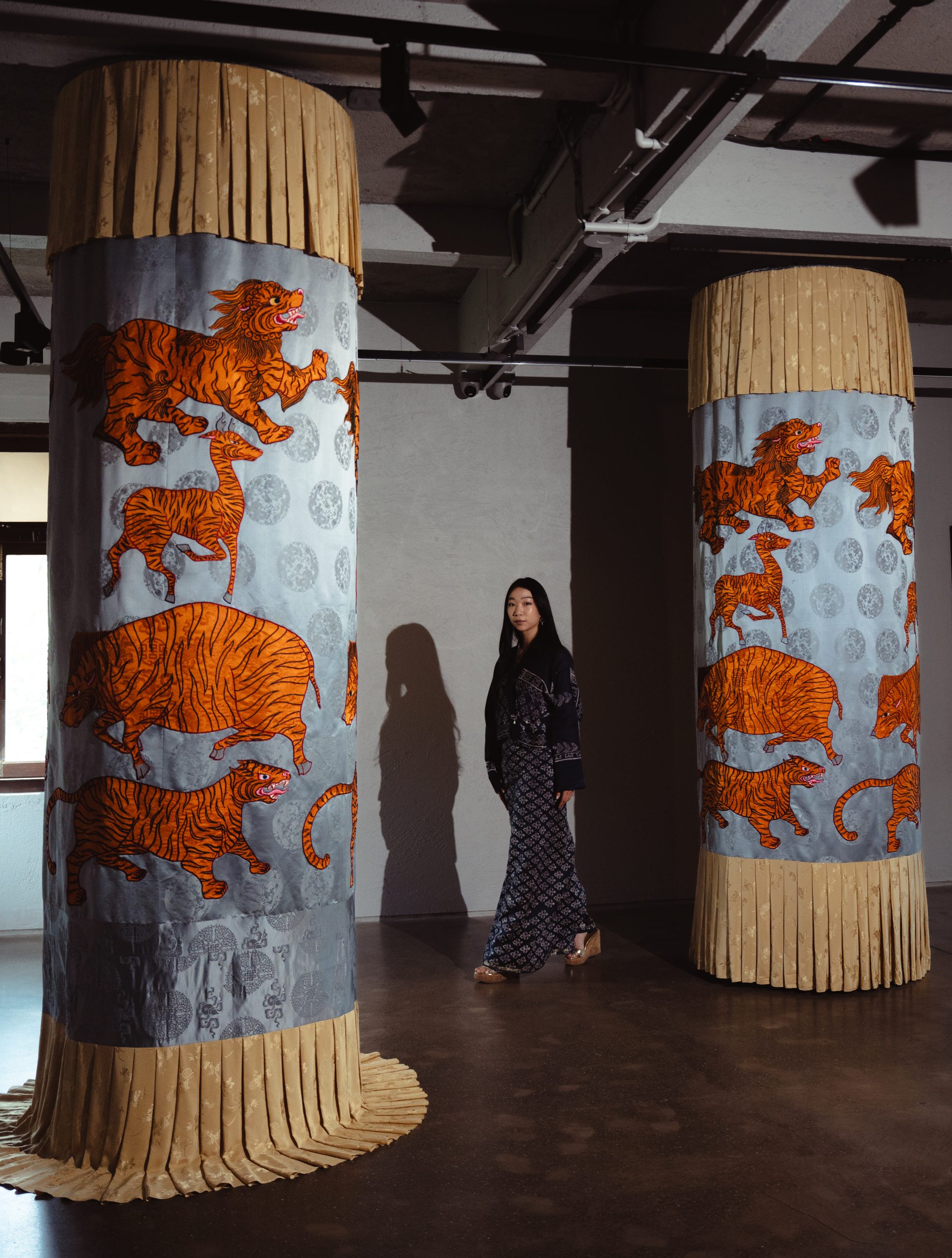
This projection becomes visible in her puzzle-like compositions, where the tiger is shown in a frolicsome, child-like light. A second reading, of course, goes deeper when one considers the new, unlikely protagonist added to accompany her recurring one — a deer that follows and exists with what is its natural predator, expanding on the notion of societal roles. Here, Zimbiri extends the philosophy of her work and questions the evolving community dynamics that envelope her relationships with others. “We all move between positions of strength and vulnerability throughout our lives. Neither role is inherently better or worse; they just ask different things from us,” she asserts. The relationship in question becomes less about conflict, and more about awareness. “It is a reminder to notice where we stand in any given moment, because that awareness shapes how we choose to respond—with compassion, restraint, courage, or understanding,” she adds. An interesting element remains to her usage of masks, where the deer dons the appearance of a sly tiger and the tiger appears to be a delicate fawn, breaking the rigidity of the natural convention. The paintings almost urge the audience to wonder: What roles do we perform, and where do we stand in our communities?
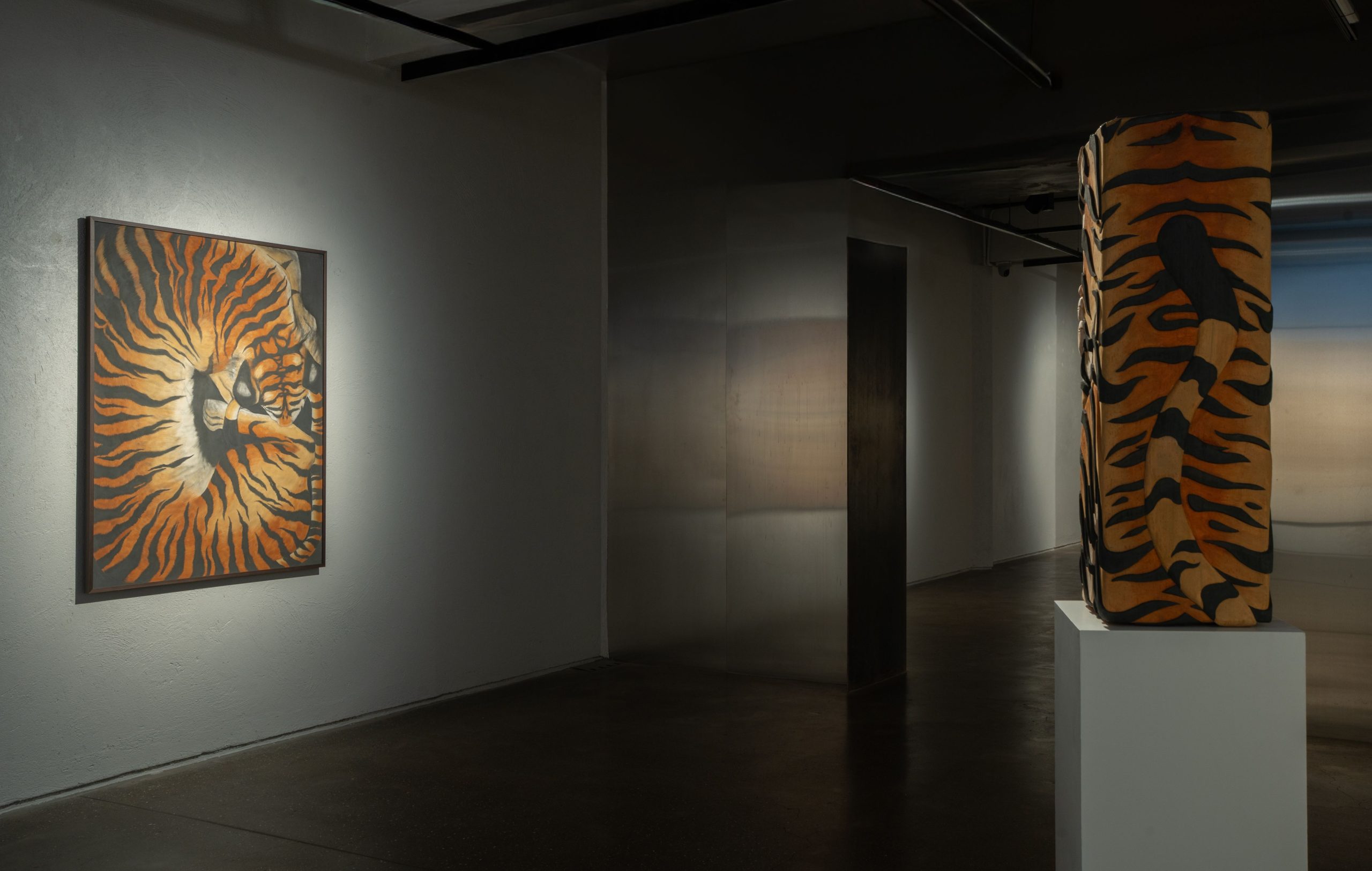
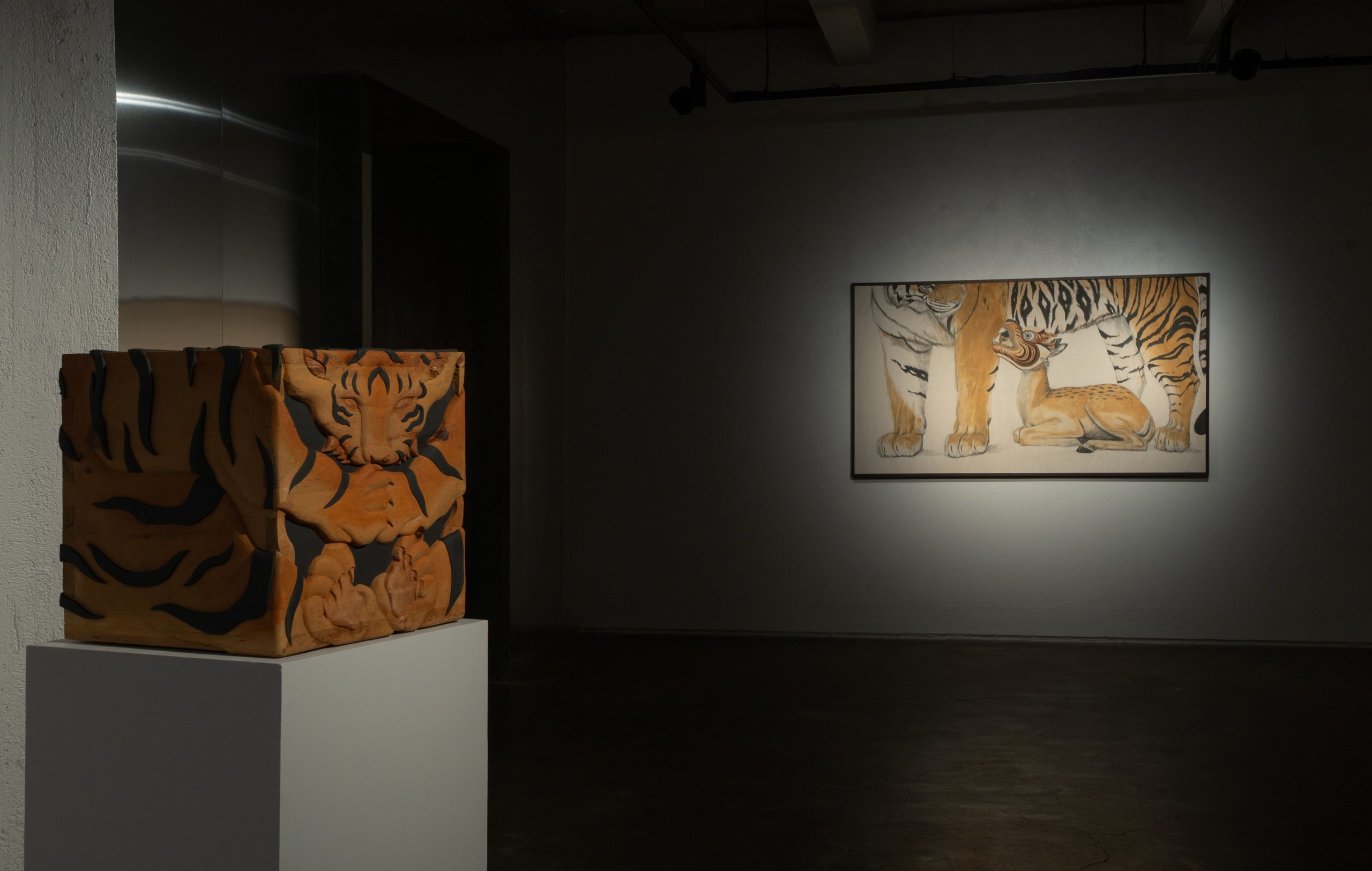
Installation views of the show featuring paintings and wood sculptures
Zimbiri’s material approach is as refined as her narrative one. The artist opts for the traditional Bhutanese medium, saa-tshen, an earth pigment that is her choice of colour, paired with rhay-shing, a hand-woven canvas for her paintings. Her choice reflects her dedication to pay homage to historically unnamed maestros who championed the region’s art language.
For this show, she let the material take the lead and created sculptures to accompany her paintings and fabric work, a major development in her style, where her earliest fascination with art came from the unlimited possibilities of a flat surface. “Instead of bringing a three-dimensional world onto a flat surface, I’m taking something that first existed in a painting and allowing it to step into our physical world… Almost like pulling characters or worlds from storybooks and allowing them to exist outside the page. That still feels like a kind of magic to me,” she shares. It’s a full circle.
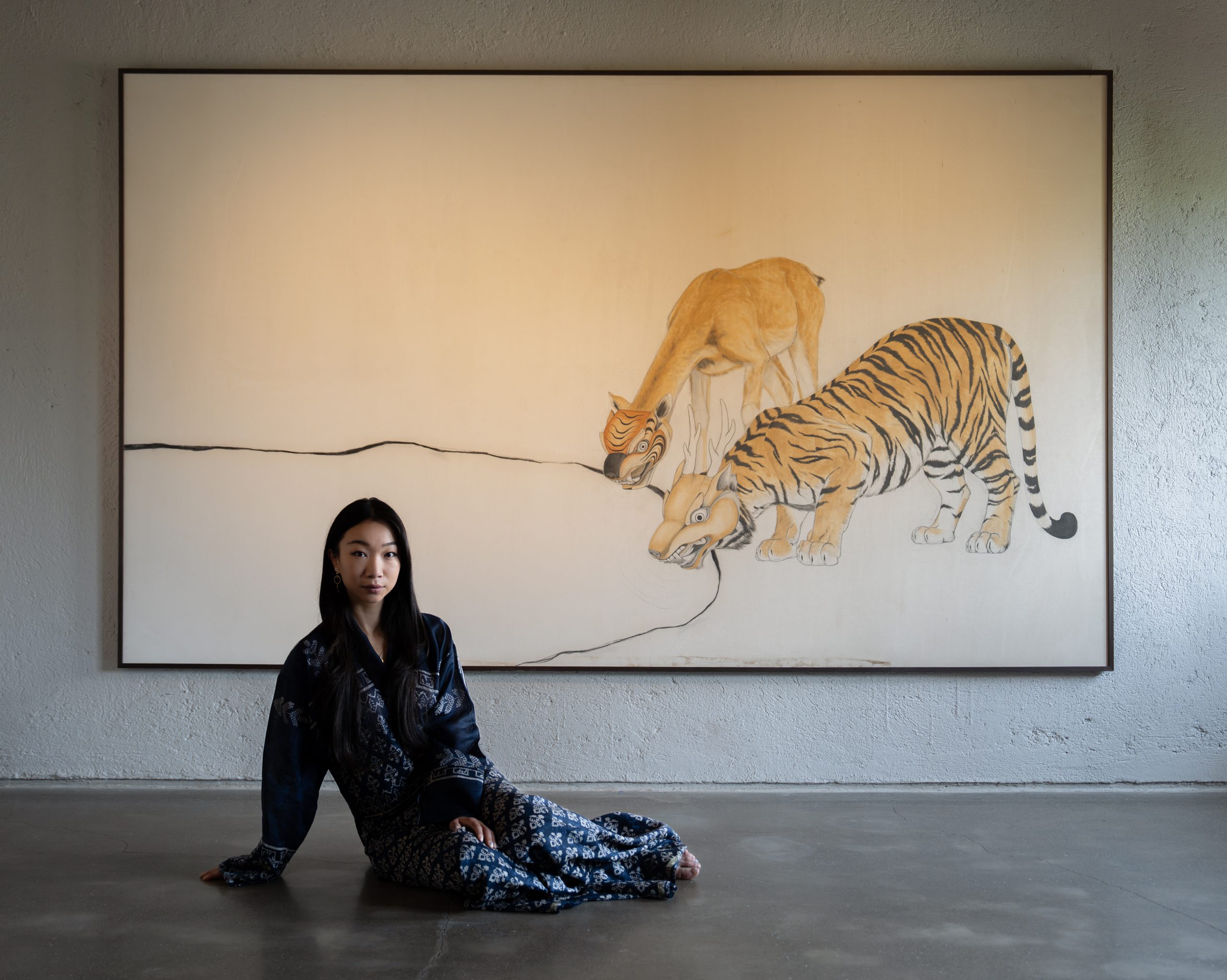
Zimbiri’s ongoing exploration on identity, and its relationship with community culminated in the exhibition, Dear Tiger
With Dear Tiger, one wonders what lies behind a motif: Under our spiritual and behavioural beliefs, what keeps a community culturally sound? What seemingly natural laws allow a society to exist in comfort, not insecurity? When a motif is stripped away from its communal understanding and observed with a personal eye, perhaps it is only then that we understand the weight of its existence.
Words by Tanya Syed
Feature image courtesy of the artist & Nature Morte, photographed by Akik Rahaman