For many, the grandeur of Rajasthan lies in its desert. I do not concur. The state’s splendour is best realised in the rolling Aravalis, tall and proud. Some of the oldest geological formations in the world, the ancient hills envelope famed kingdoms and their lore. When the desert dust gives away, the hills remain unbothered. But maybe I’m biased. Growing up a stone’s throw away from the range’s highest peak, Guru Shikhar, one cannot help but find themselves tethered to the landscape. The hills nestle unparalleled heritage, and towards its southern edge, they hold a gateway to God. In the temple town of Nathdwara, Lord Krishna takes the form of Shrinathji, the principal deity of the Pushtimarg sect. Shrinathji finds his place at the foot of the Aravalis, a pulsing influence on the surrounding localities.
“My earliest memory is of my grandmother praying with beads in her hand. She was a devout pushtimargi,” Abhijeet Karwa, architect and curator, tells me over a call. The multihyphenate traces his roots to Udaipur — Rajasthan’s city of lakes, the historic capital of Mewar, less than an hour away from Nathdwara. “When you grow up in this city, there are two places that demand attention, the City Palace and the temple,” he asserts. Karwa — in collaboration with Udaipur-based textile label Aavaran and Maharana of Mewar Charitable Foundation — duly brings the two together in the special exhibition, Sudarshan at the City Palace Museum.
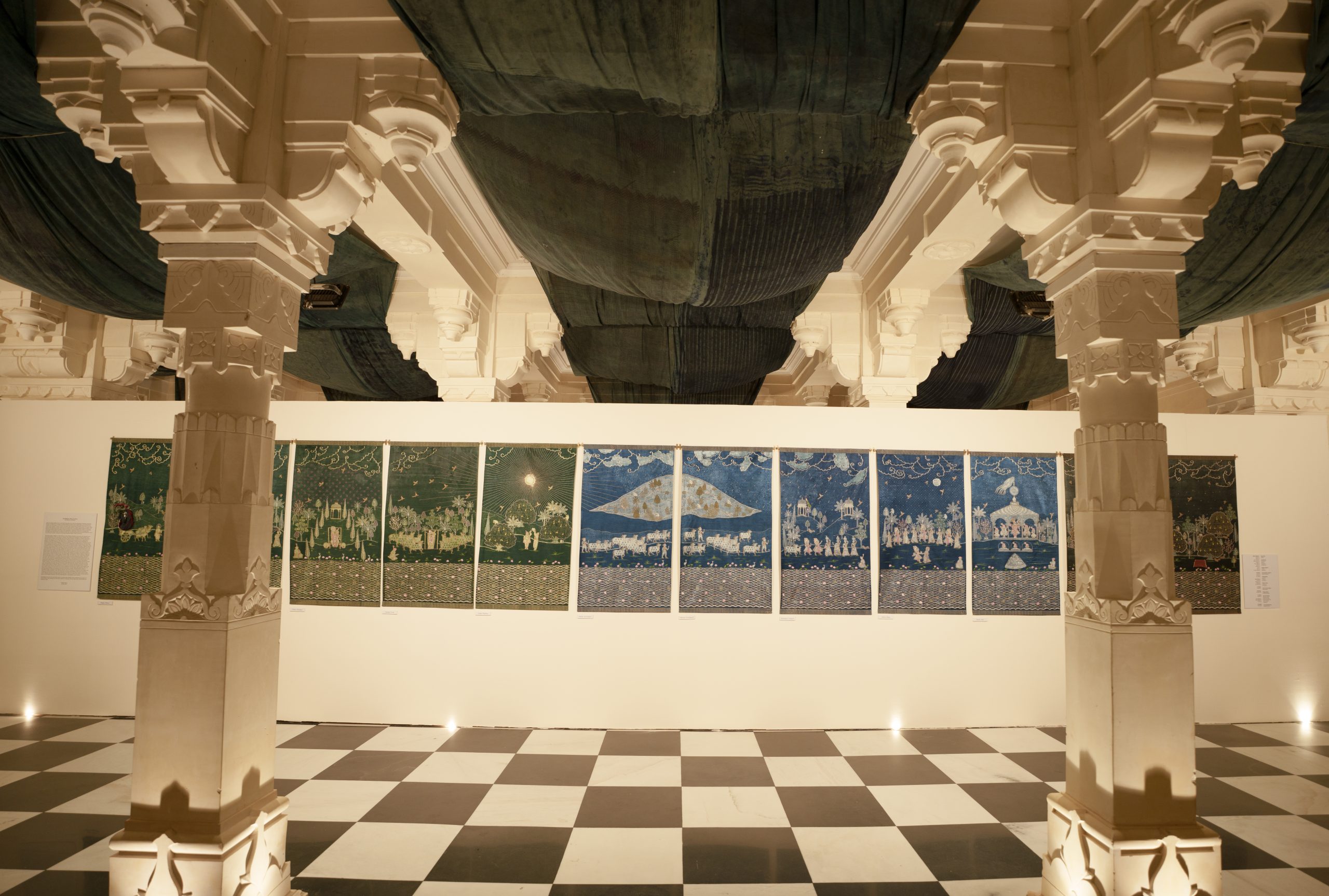
Sudarshan, a 27 ft craftwork that represents a devotional offering to Shrinathji, is a collaborative effort between Udaipur-based label Aavaran, curator Abhijeet Karwa, and The Maharana of Mewar Charitable Foundation
With 12 panels unfolding like a scroll, Sudarshan amounts to exactly 108 sq ft of intricate handiwork undertaken by the talented artisans at Aavaran. The label was founded by Alka Sharma, whose initiative led to the revival of the lost block-printing technique of Dabu. “This moment is particularly special, and fitting, because my first collection was dedicated to Krishna, too,” Sharma shares. An ode to the landscape of Udaipur and by extension, Southern Rajasthan, the exhibit simultaneously circles through a lunar cycle, a Hindu calendar year, and the many darshans (and their moods) that one engages in at Shrinathji’s temple. “Sudarshan offers you a glimpse of what a day in Shrinathji’s haveli in Nathdwara looks like,” Karwa says.
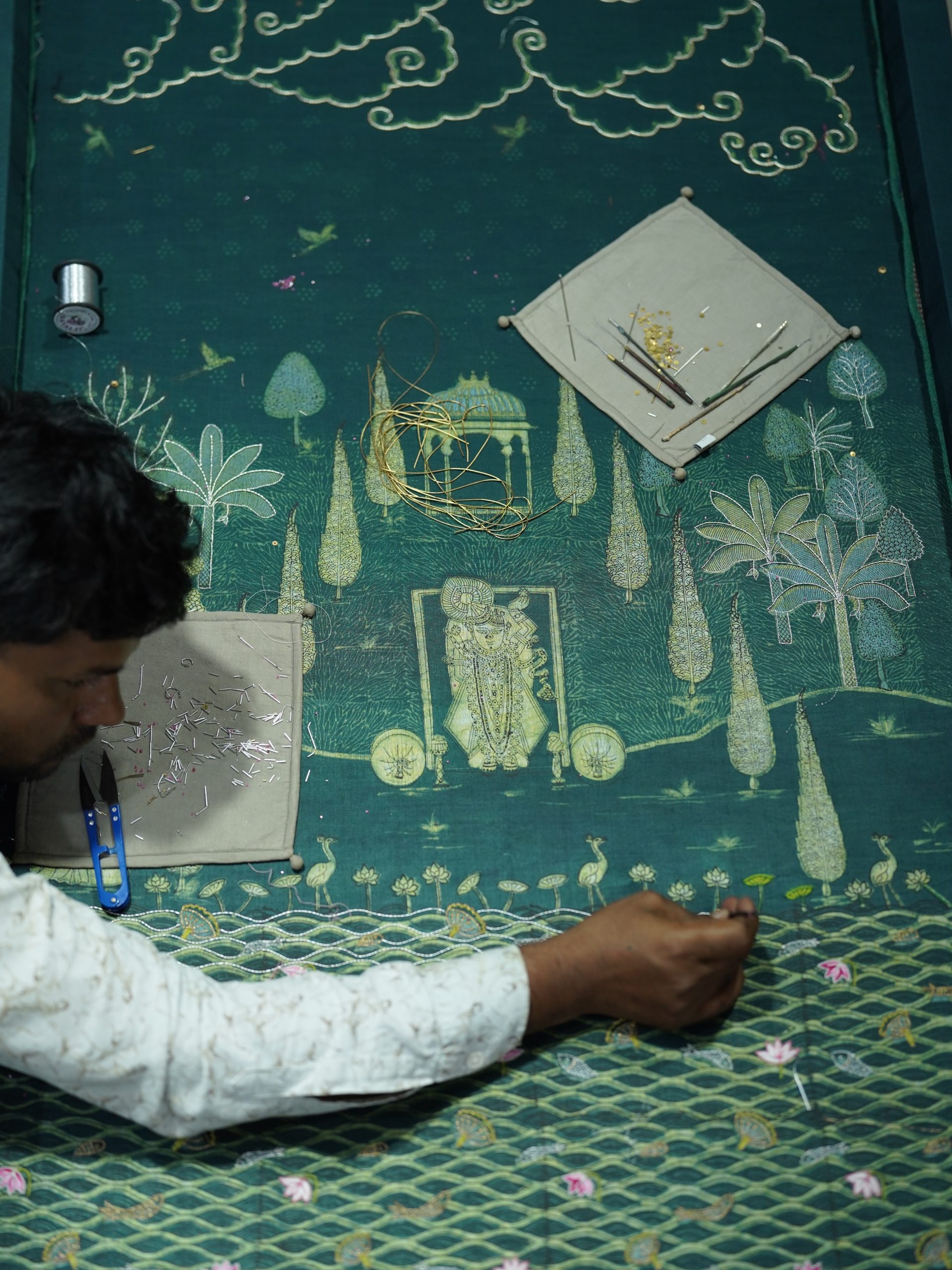
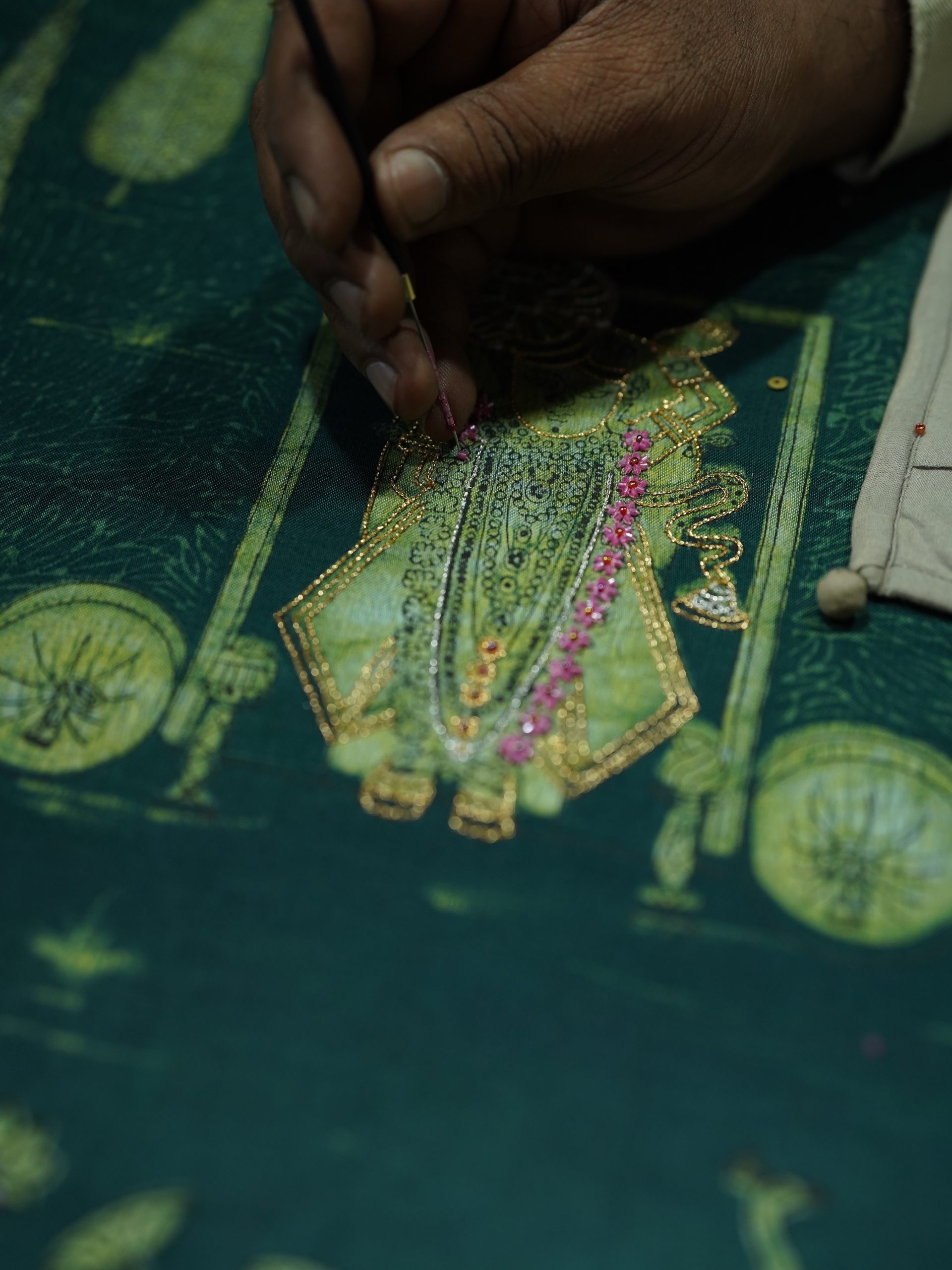
The panels were completed with fabric dyed in natural indigo, eventually embellished with traditional Dabu block printing, and Aari and Zardozi embroidery
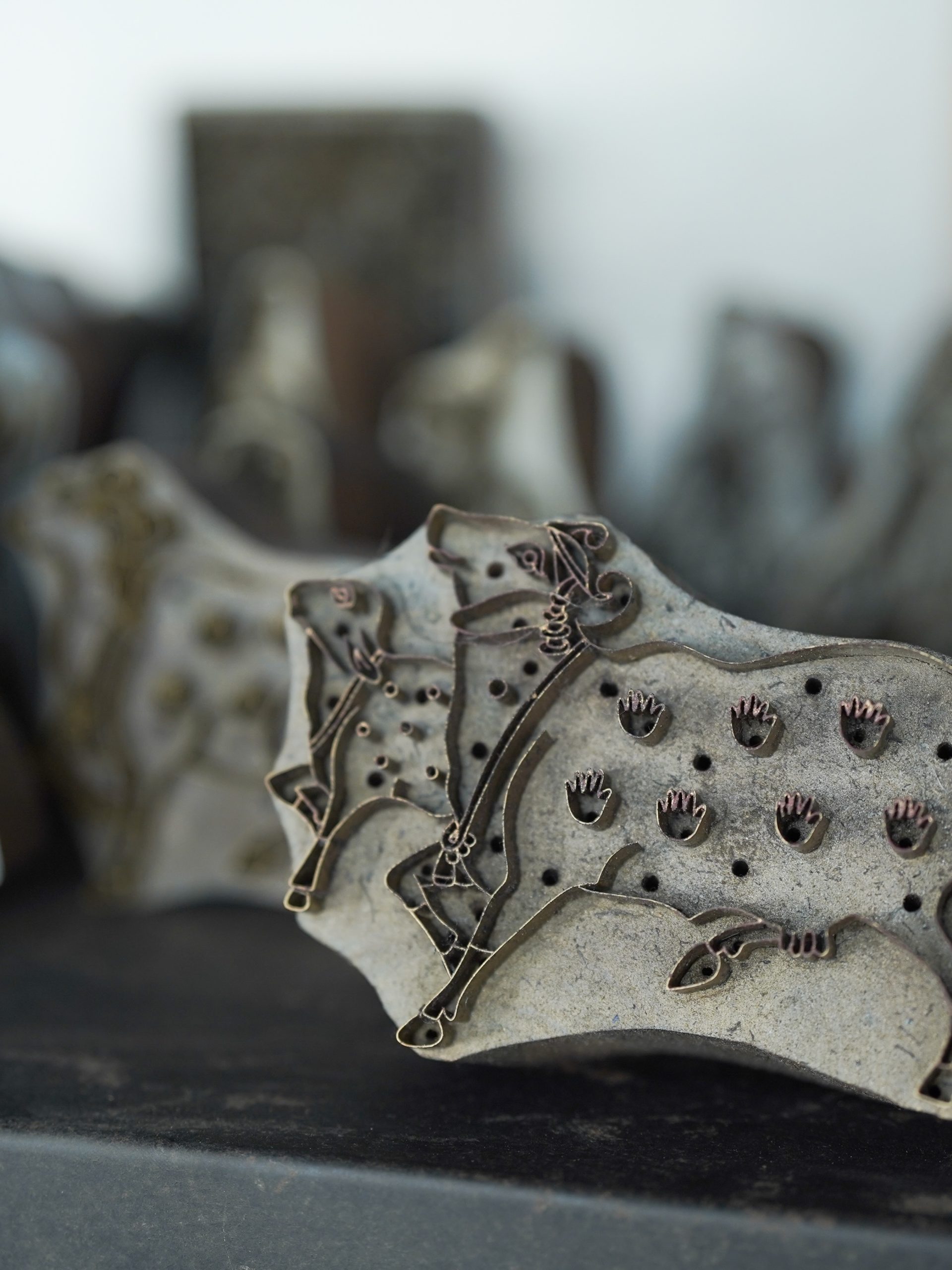
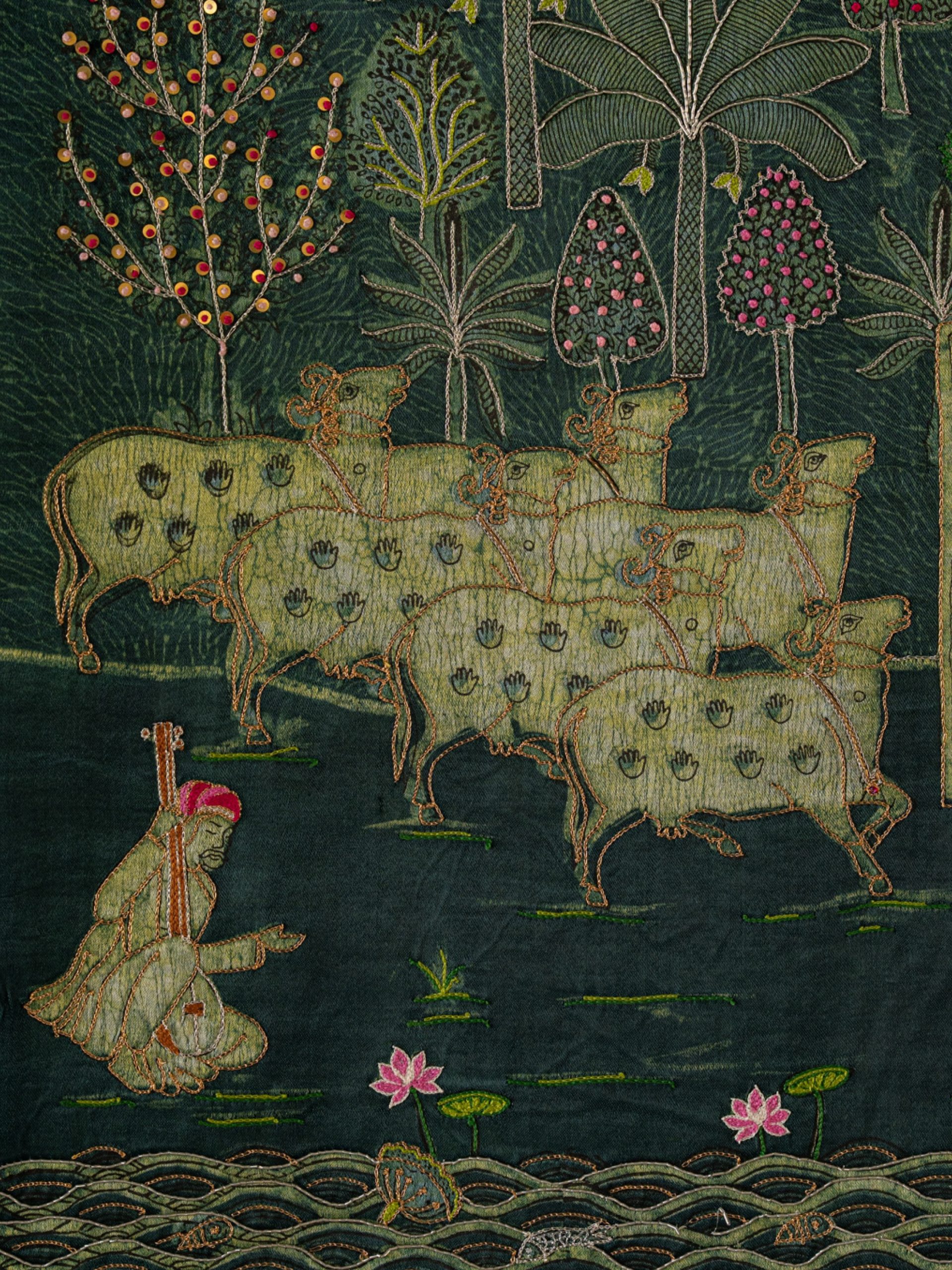
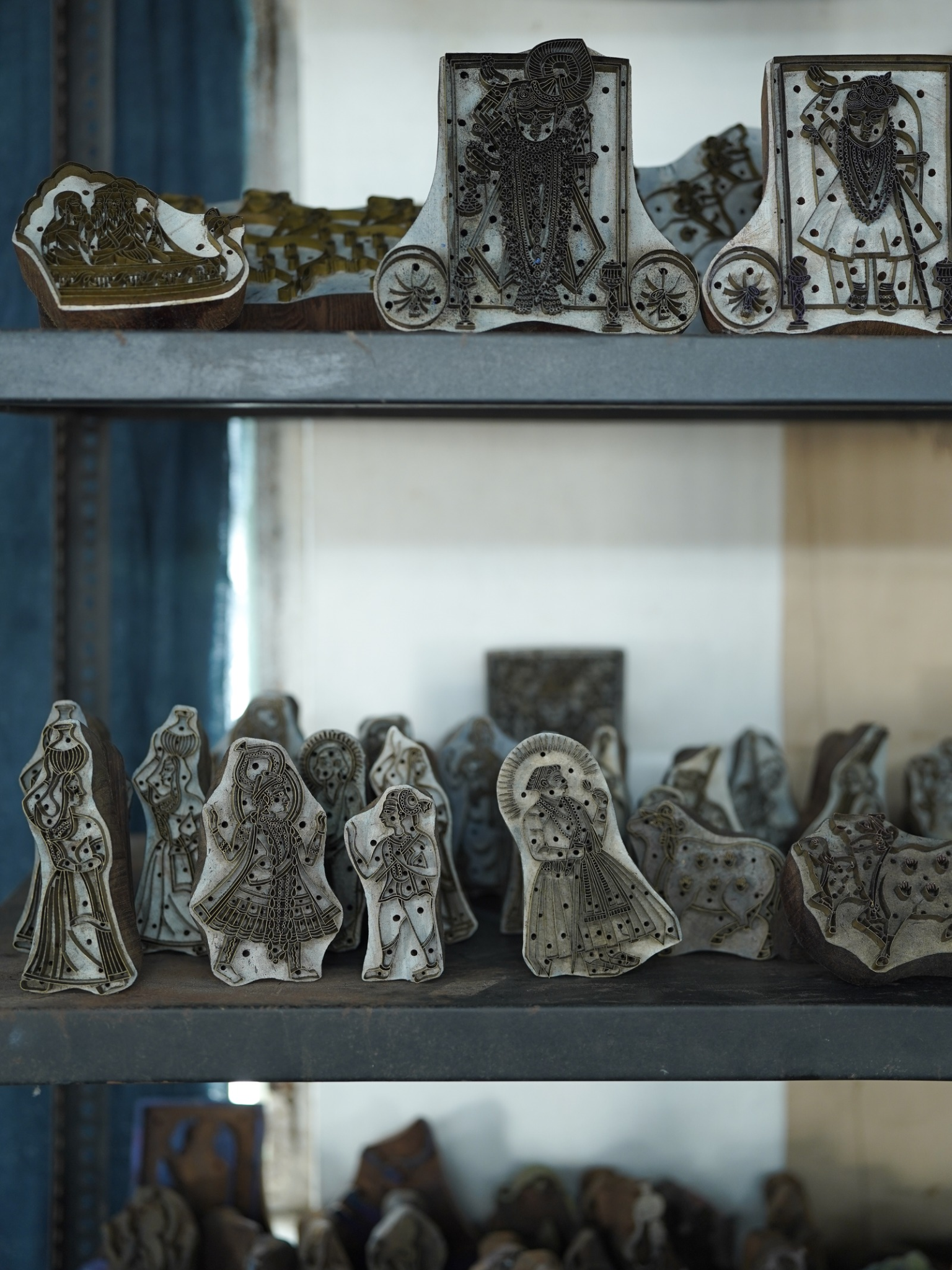
The beauty of the project lies in the many references and traditions it brings together. A special Dabu blockprint was used for every element
Reminiscent of the pichwai tradition, the panels coax you into considering the connection between the kingdom of Mewar and the path of the Pushtimargis. While the sect originated in Mathura in the 15th century, growing hostility in the region urged the tradition to find a new place for their deity. Damodardasji, a disciple, marched westwards. The chariot broke in Sihad near Udaipur, and Shrinathji found a new home. “Perhaps a king cannot protect God, but he can offer his kingdom in service. And so begins Mewar’s custodianship of Thakurji, marking the establishment of Pushtimarg in this land,” Karwa writes in his statement.
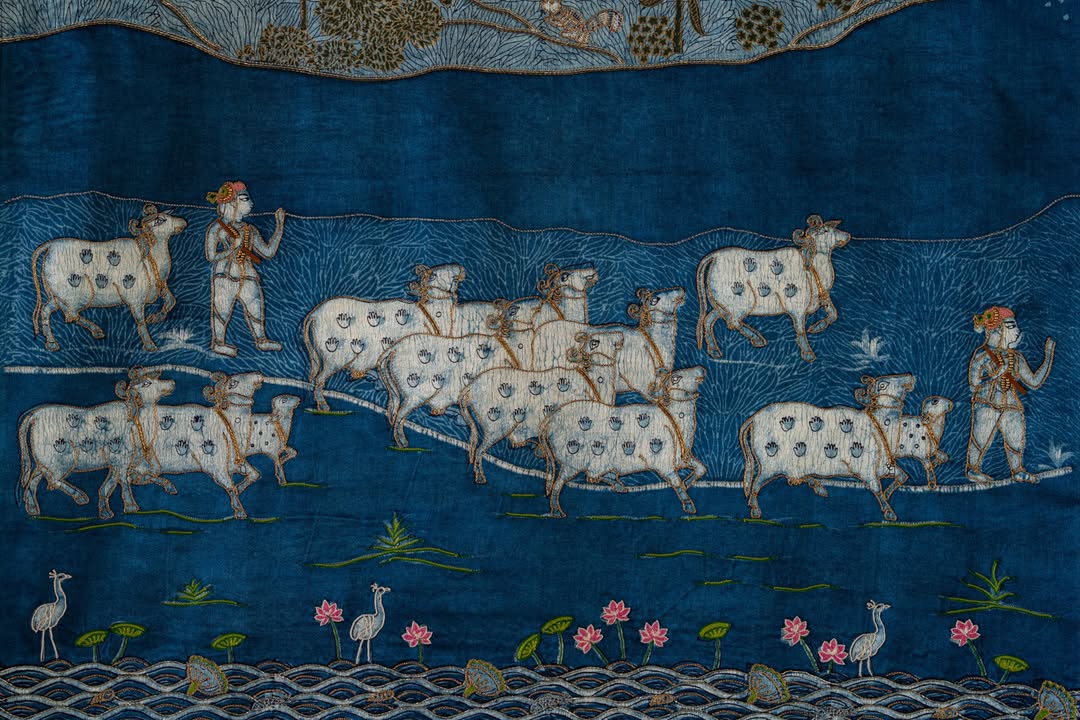
Throughout the work, we witness elements that invoke the many traditions associated with seva (worship). A gulaal features in the first panel depicting the month of Phalgun, where the festival of holi is celebrated every day. A cowherd is said to be the first to discover Shrinathji; undoubtedly, the animal remains inseparable from this story. The day and its offerings are attuned to the deity’s many moods, so one spots a mirror: Set there so the God may please himself with his appearance. We flow through the festivities of Snan Yatra, the respite of a cool monsoon in dry Mewar, and his rendezvous with his many leelas. Exemplifying this grand, playful character of the deity is the scene that is set before him, complete with poetry and music, food offerings, and varied adornments. The final panel concludes with Shrinathji returning to Madhuban to reunite with Radha, “My favourite part about this work is that it ends on an affectionate note, where Krishna leaves to be with his love,” Sharma shares.
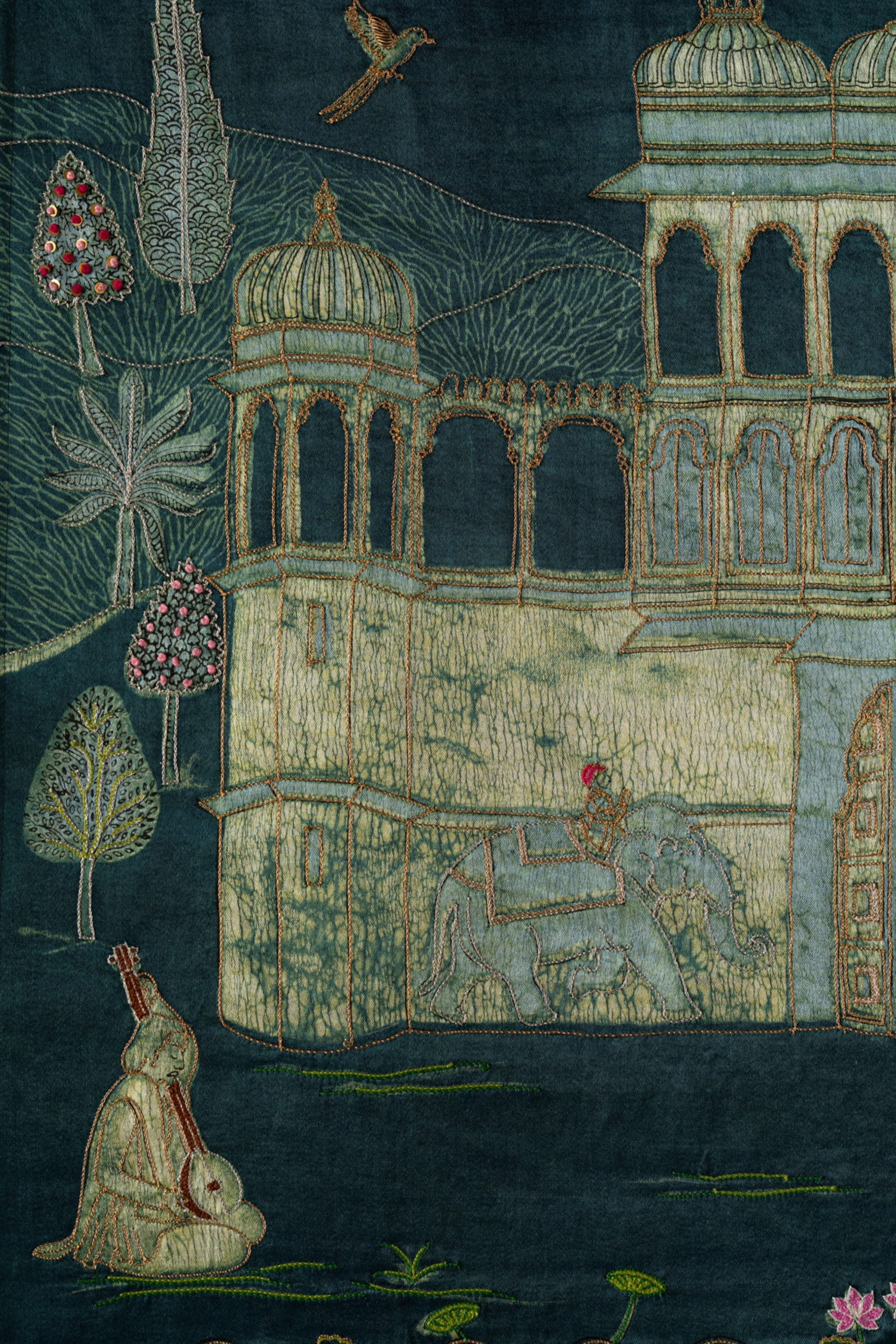
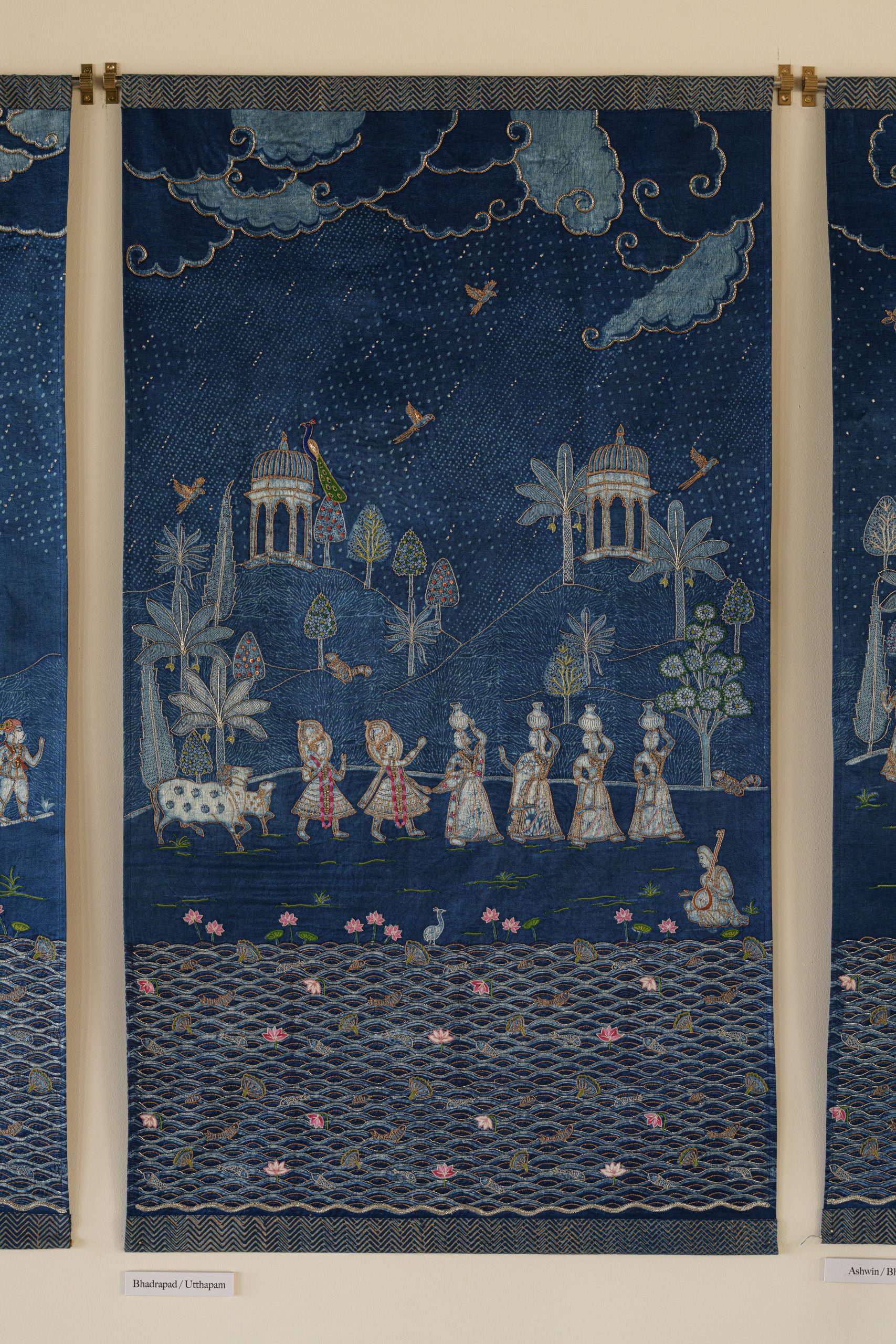
(L-R) Staying true to tradition, seva meant to please Thakurji is incomplete without music; in the monsoon, Thakurji finds time for his leelas
Love and devotion are deeply etched in Sudarshan, and it is a personal tethering to both the city and the religious tradition that brings both Karwa and Sharma together. Prompted on whether either could have completed this behemoth without the other, and the answer remains a consistent “no”.
With Aavaran, one is welcomed to touch and feel the plethora of craft knowledge that the region possesses. “Translating an offering as conceptually vast as Sudarshan demanded the full breadth of our artisans’ technical mastery over Dabu mud-resist and indigo dyeing,” Sharma shares. The panels come alive with bespoke block-carving, complex mud-resist printing, layered natural dyeing, and fine metal zardozi embellishment. Completed within a mere few months, the label showcased its expertise and excellence in delivering a work that materialises its maker’s personal devotion. “This collaboration with the Maharana of Mewar Charitable Foundation is deeply meaningful because it places indigenous craft back where it belongs, at the heart of Mewar’s living cultural narrative.”
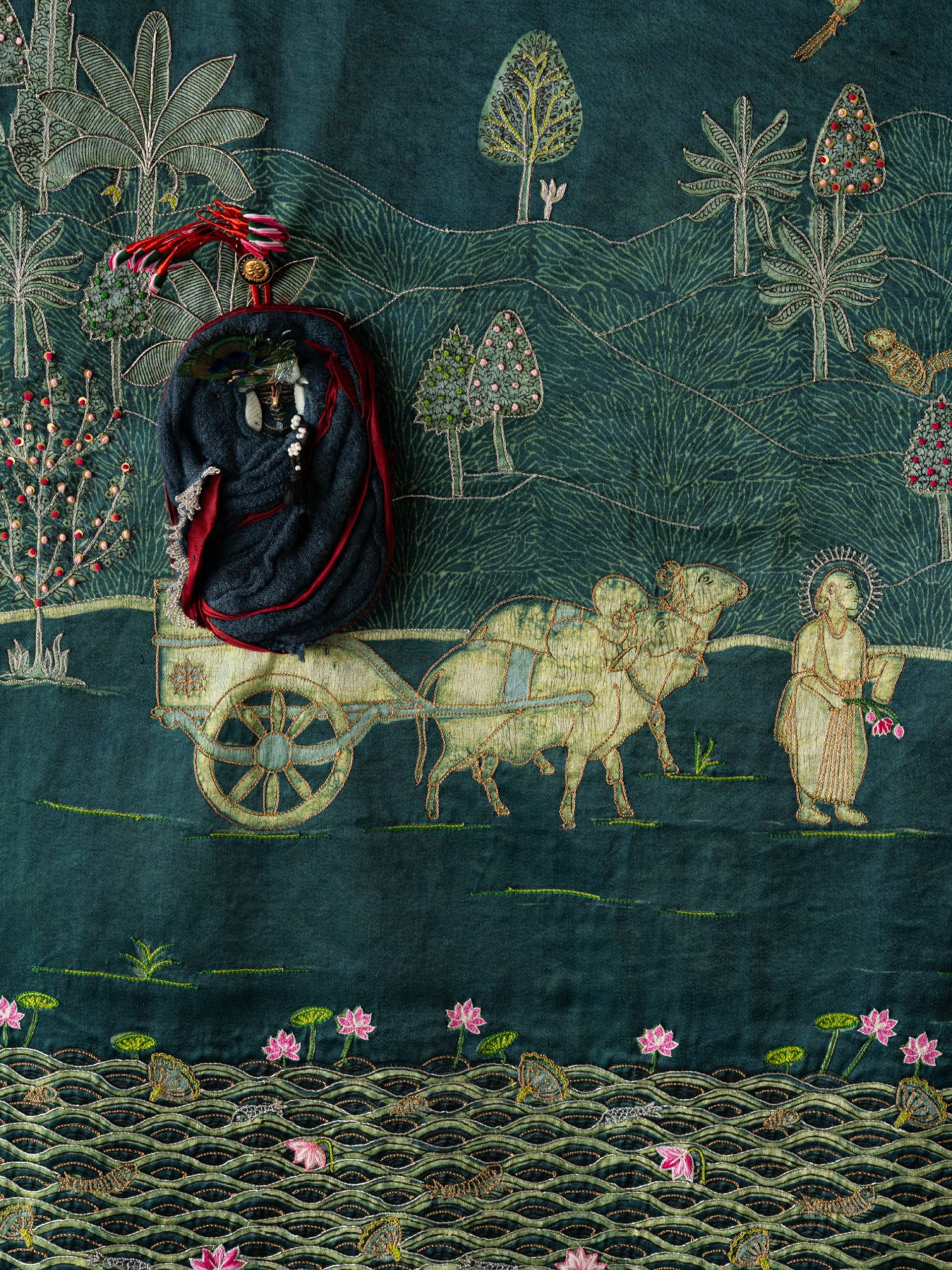
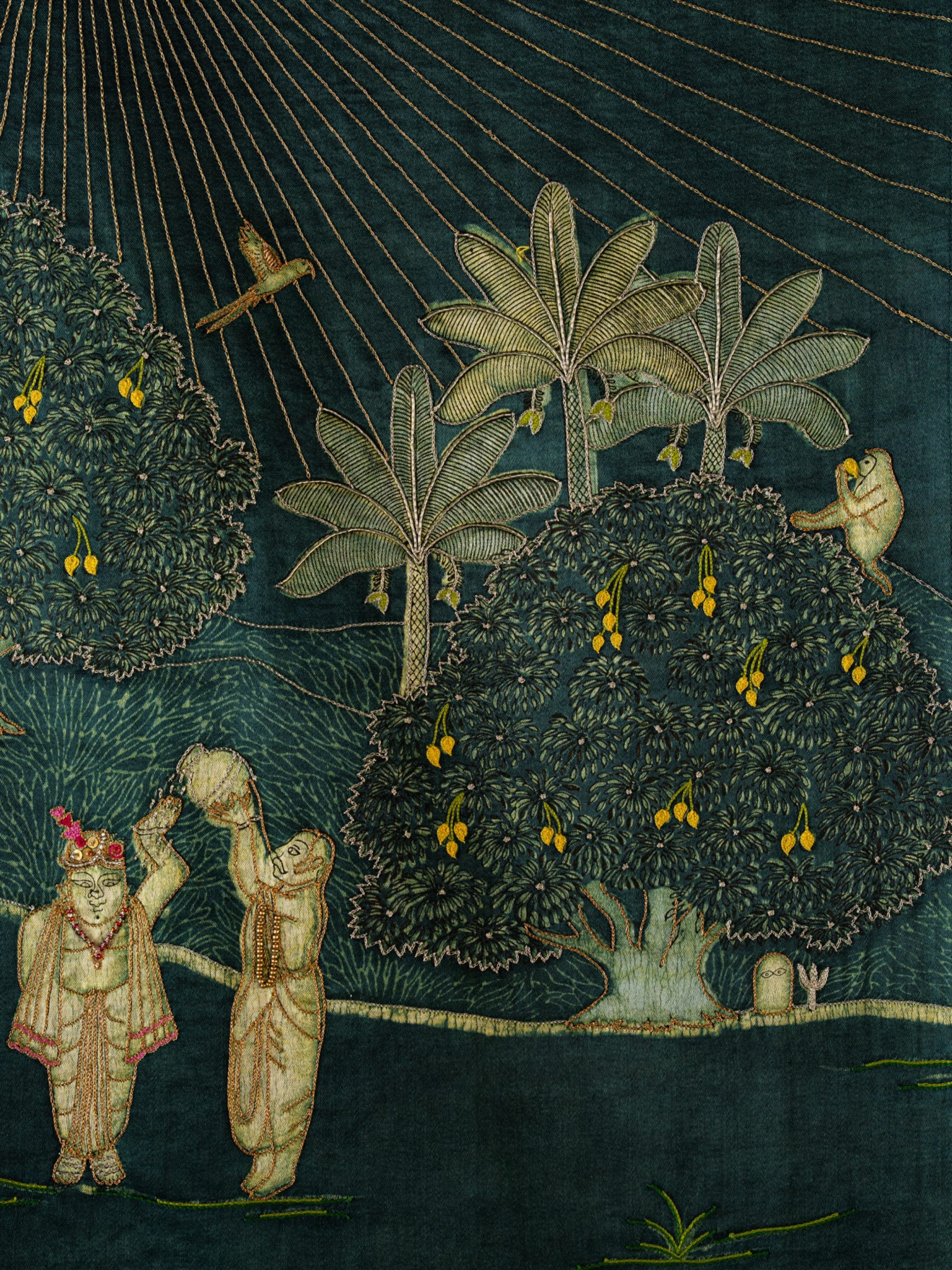
(L-R) Thakurji arrives in Sihad, 50 kms from Udaipur, wearing pashmina; Shrinathji in the summer landscape. In the right, one can spot traces of the region’s indigenous folklore
In Karwa’s curatorial capacities he discovered the enduring cultural effect of the tradition. In the fifth panel, he offers a complete perspective: Adding in relics of old mountain Gods of the hills, he manages to let the viewer in on the region’s layered history.
It is in their lasting dedication to the region, that we discover a devotion that extends beyond the religiosity of the panels. Sudarshan, is in seva of a God, but it is also in seva of his land and its bounty.
Words by Tanya Syed