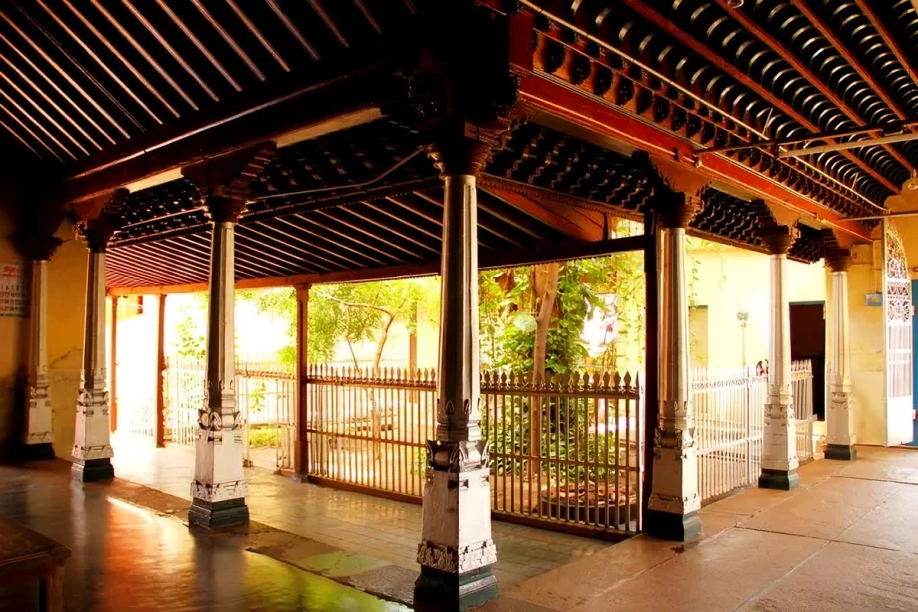
A flood, remembered but never dated, is where the Chettinad story begins. The community’s oral histories place Chettiyars’ first home at Kaveripoompattinam, a port on the Cauvery delta, swept away by a flood sometime between the 8th and 13th centuries. From there, the community moved inland to the drier landscape of Chettinad, where the scarcity of rain offered protection from flooding while groundwater remained accessible.
Also called Nagarathars, their maritime networks expanded significantly under British rule, as colonial trade opened new commercial routes and opportunities. By the 19th century, their trading and banking ventures stretched from the port cities of Colombo and Penang to Singapore, Rangoon and Saigon. What they brought back home was not objects and materials, but architectural possibilities. The port cities where they did business were marketplaces of exactly that kind. A 1927 Singapore Free Press advertisement announces a fresh consignment of Italian marble flooring tiles, cut to standard sizes. No longer an inaccessible European luxury, Italian marble was now a building material in Singapore’s marketplace, ready for use. For a Nagarathar merchant there, it was simply part of the material world around him, brought within reach by the same commercial networks that moved his own goods and capital.
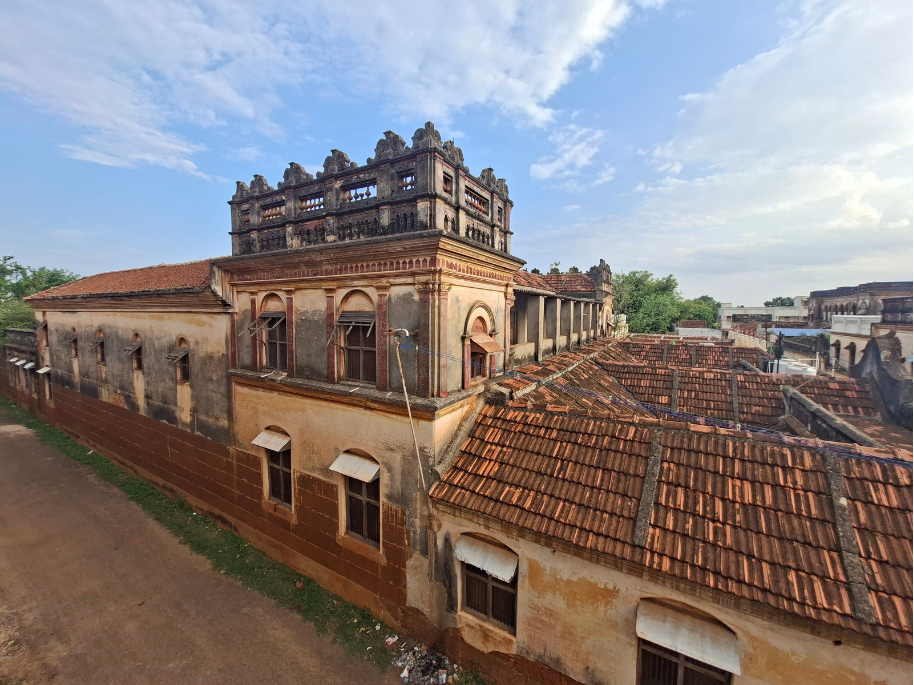
The weathered streetscape of Pallathur — laterite stone foundations, brick-and-lime facades, ornamental cornices and parapets, and traditional Mangalore and country-tiled roofs
Another auction notice for the contents of a European household in Singapore lists an English billiard table, majolica ware, Satsuma vases, and Indian carved work — British, Japanese, Indian, and Southeast Asian objects in a single drawing room. For merchants with the capital and standing to buy them, it was never a distant curiosity. It was part of the world they moved through — visible, purchasable, and ready to be carried elsewhere.
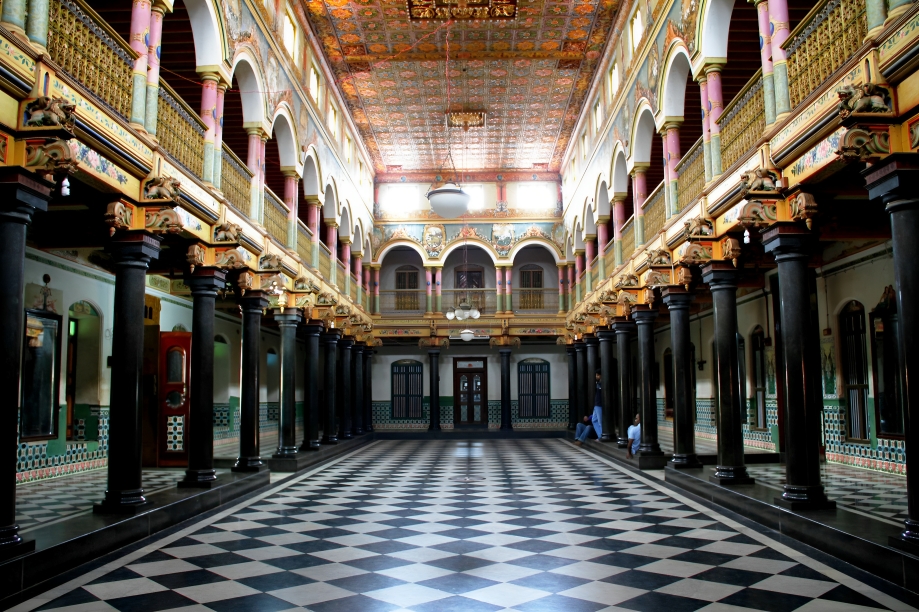
The hall at Athanudi Palace, connecting the valavu (courtyard) to the mugappu (front yard)
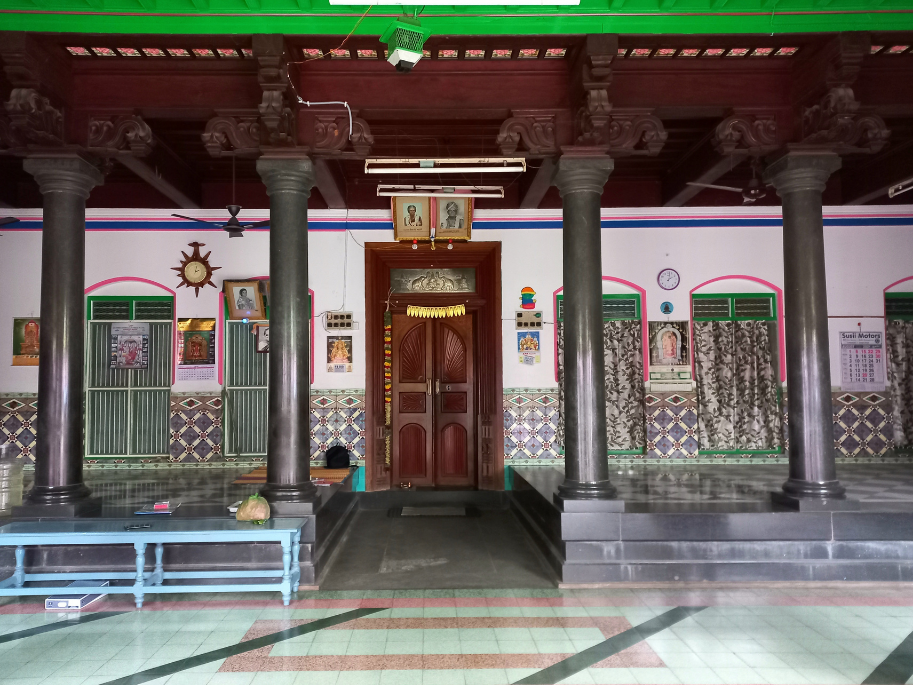
That “somewhere else” was mostly a Chettinad mansion, where the first impression is architecture performing at full scale: Tall pillars, checkered floors, and an imposing door carved in exquisite detail. On either side of the door, a raised, open platform called the thinnai extends along the walls, serving as an informal office and social threshold where business was conducted and guests were received. The grandeur makes it easy to miss the countless smaller decisions that make such a house possible. Look closer at the height of a seated person, and the tile reappears. This time not on the floor, but on the wall.

(L-R) The facade of a modest Chettinad mansion, seen from the street, with a broad flight of steps leading to the entrance; the mugappu (front yard) where the house’s global character is on display: Marble, tile, teak, and glass
The glazed majolica tiles, rooted in Renaissance Italy, were mechanised and marketed in Victorian Britain as markers of modern taste before entering India through colonial showcase buildings such as the Madras Council Chamber. When Britain’s tile industry buckled after the First World War, Japanese manufacturers took over the market. In Chettinad mansions, majolica tiles go up the walls to roughly three feet, the height of a seated body. Lime plaster on walls, soft and porous, wears down under repeated contact. Placed precisely where bodies meet the wall, the tiles form a durable buffer against everyday wear. What looks like decoration is also a simple act of maintenance.
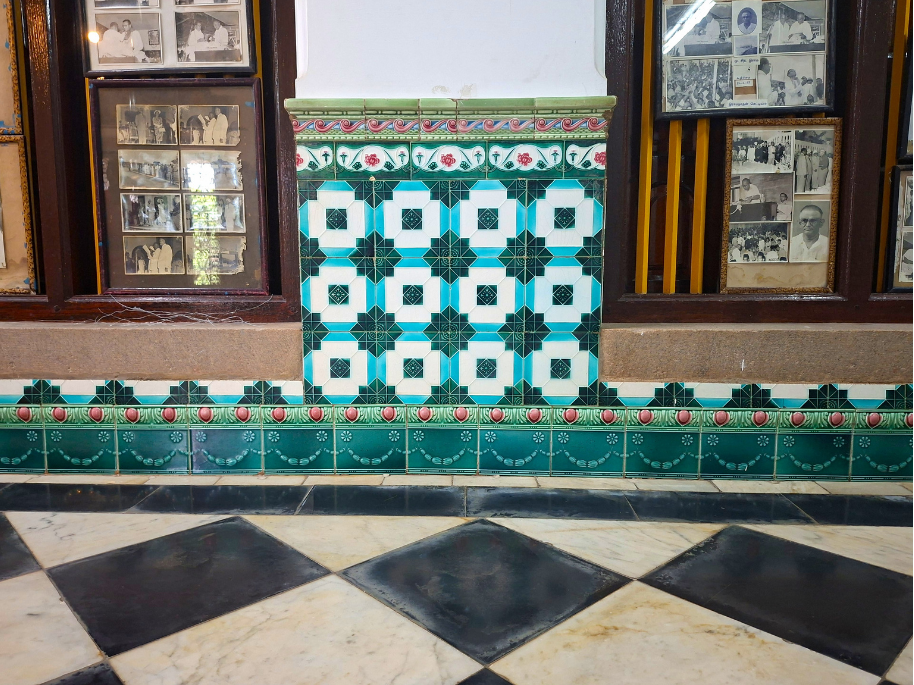
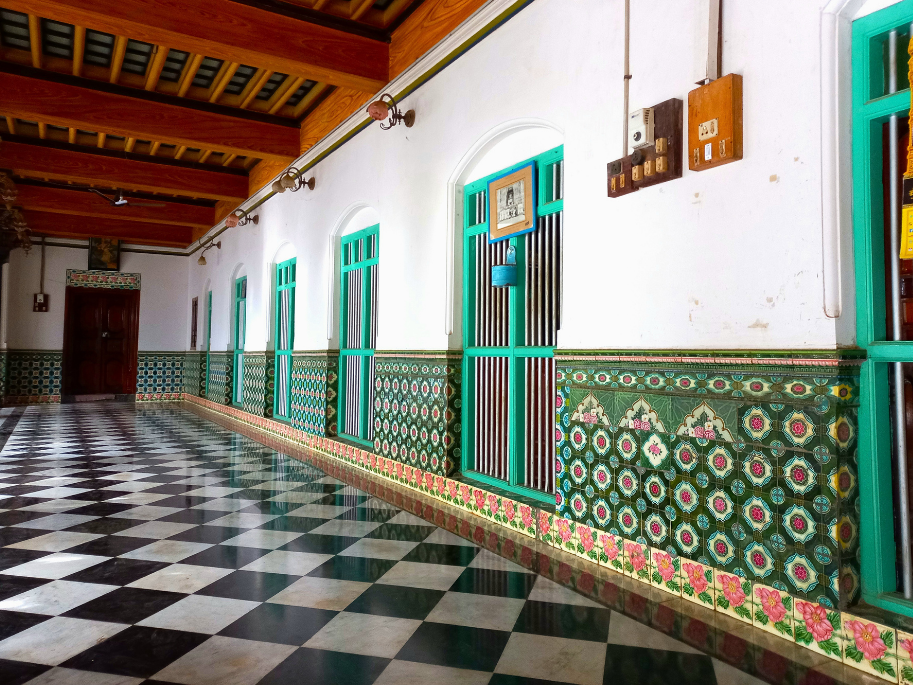
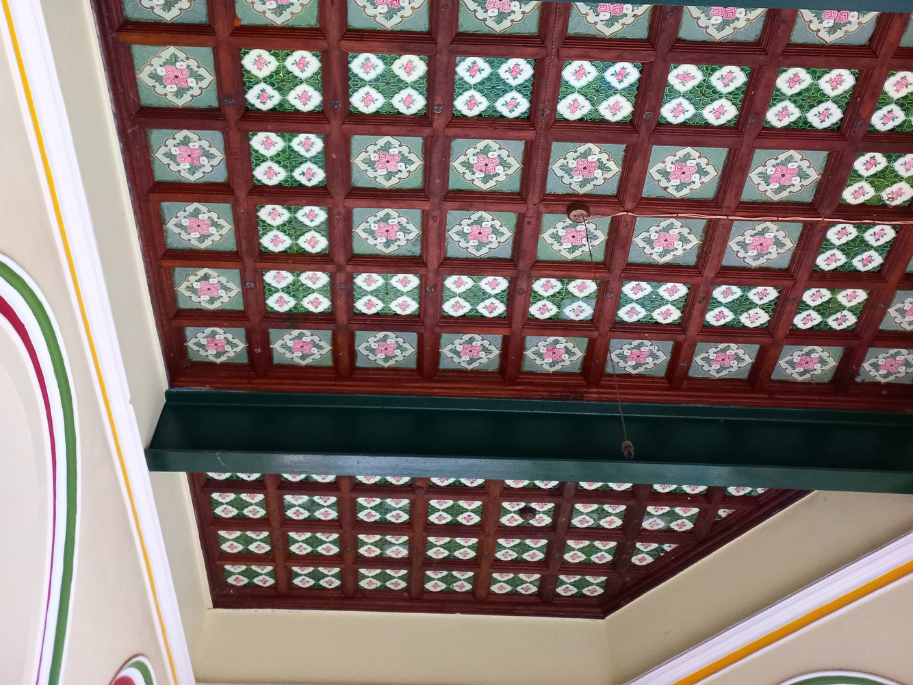
Majolica tiles run along the thinnai walls and across the ceiling, set into its timber-and-brick frame
Belgian glass pushed that instinct further. It arrived as a plain commodity, sheet mirror, sold by the pane. These mirrors don’t appear in private quarters, where mirrors would usually be found. They’re set into the main door panels and cupboard doors of the mansion’s shared spaces, and positioned at precise points where they catch not a face, but the house itself — the run of pillars, the depth of a hall, the symmetry of a facade folding back on itself. A mirror here was placed to complete a view of the architecture that no single vantage point could otherwise take in at once.
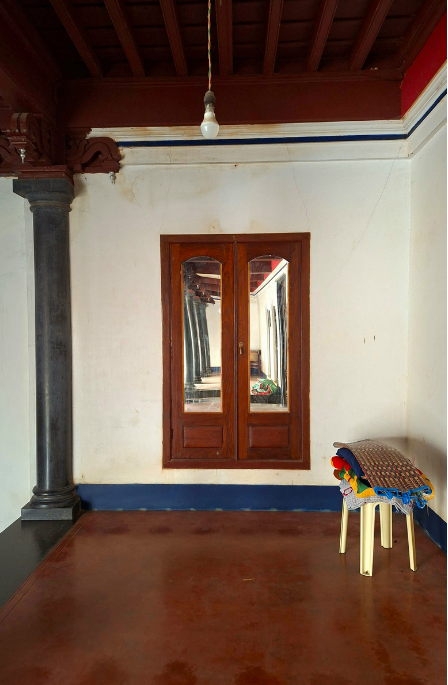
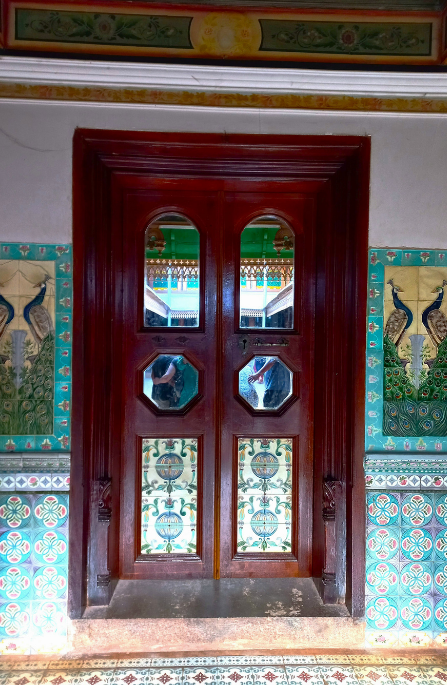
(L-R) Belgian mirror set into cupboard doors, reflecting the length of the space behind it; mirror panels in the main door, framed by majolica tiles, catch the courtyard beyond
Then came industrialisation, which brought handcrafted materials into mass production. By the twentieth century, iron was everywhere in the colonial cities — slender cast-iron frames spanning wide arcades. In Calcutta, iron entered mansions as elaborate veranda balustrades and façade details, bringing industrial modernity into the residential streetscape. Iron reached Chettinad mansions too, but found a more modest role. Built low and wide around courtyards, these houses had little need for iron’s structural possibilities of long spans and soaring heights. By the time Art Deco entered Chettinad after the 1910s, iron was largely limited to lace balustrades, gates, and grills over open courtyards.
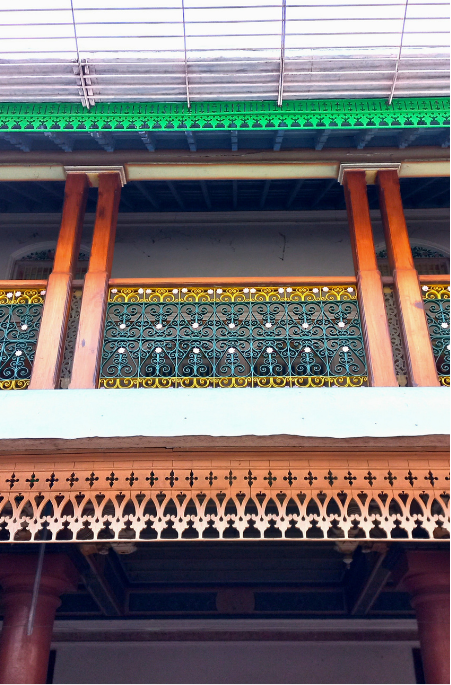
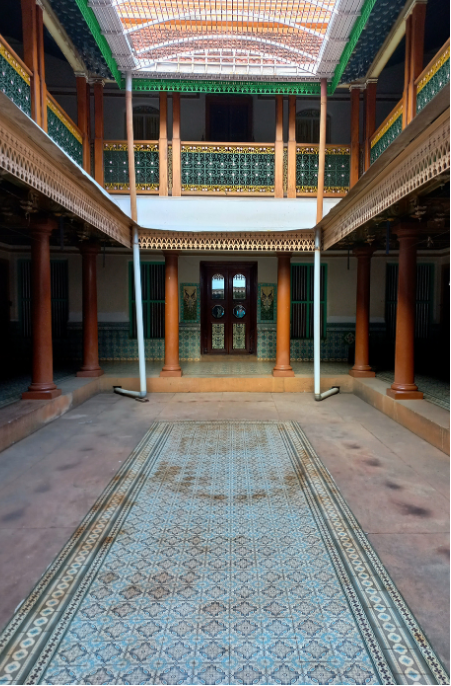
Iron balustrades and fretwork run along the parapets and eaves of the courtyard
Long before cast iron became a colonial trend, iron was an established craft material in India. That tradition can be found in Chettinad’s teak doors, fitted with elaborate iron locks made by local blacksmiths. A single entrance could have several iron bolts and latches, operated in sequence by one specially shaped key, turned once one way, then flipped to operate a second lock. The doors those locks secured were made of Burmese teak, shipped from Burma through the trade routes the Chettiars operated.
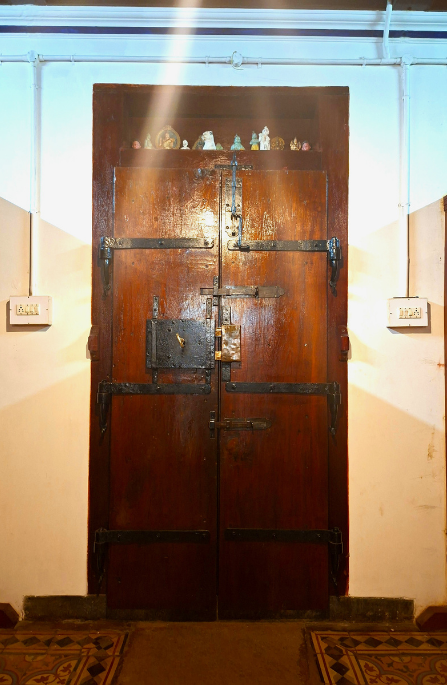
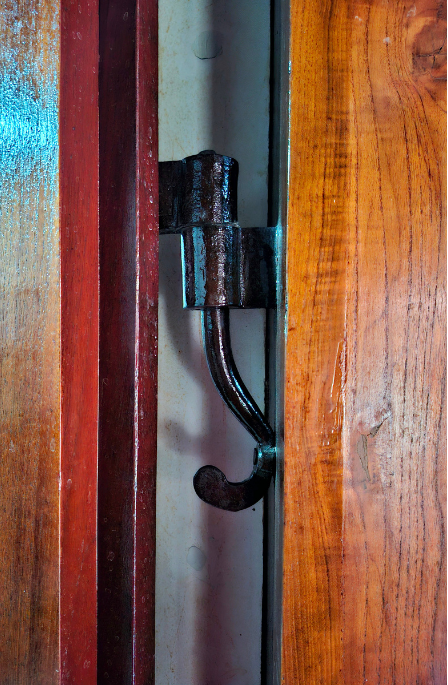
Heavy Burmese teak doors are secured with iron bands, hinges and elaborate locks
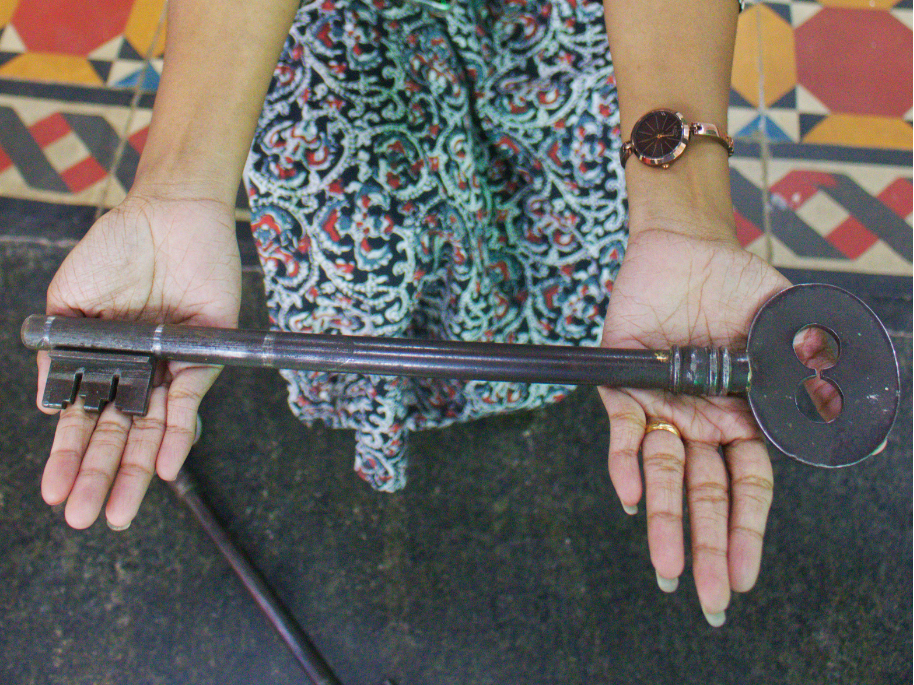
A traditional iron key, crafted by local blacksmiths for the Chettinad mansions
It was a language, worked out piece by piece, as materials from across continents became part of something distinctly local. The material arrived with its own history, a technique from Italy, a taste manufactured in Britain, or a market cornered by Japan, but acquired a new meaning here. And that meaning emerged from what the Chettiyars and masons who built the house chose to do with the materials.
Words by Meena Azhakappan