We are individually multiple — a telling observation made by filmmaker Kabir Mohanty. It is a sentence that summarises a consideration that is often denied to people. How can someone ever be one thing? Perhaps the true test in knowing a person is accepting their many dimensions. A confluence is where the action is, and artist Arshi Irshad Ahmadzai understands that. Across her artworks, she invites audiences to witness unlikely interactions between a myriad of personal references.
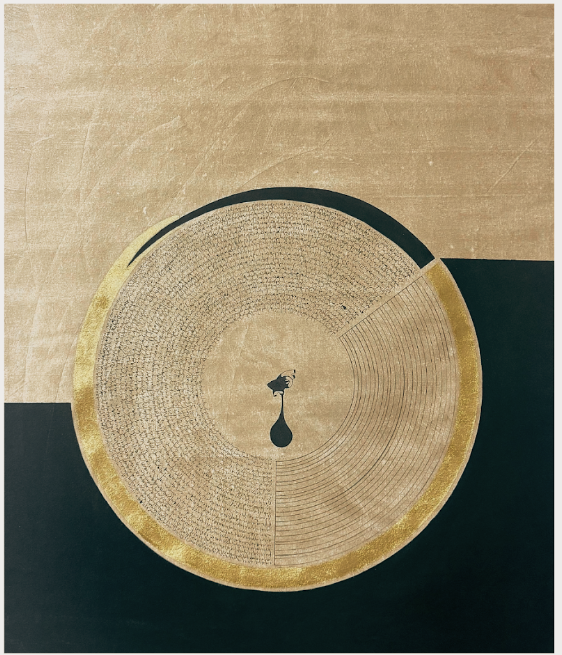
In an intricate composition titled, Dasht-e- Leili wa tanha gul-e-Lalah, the two literary savants, al-Khansa’ of Najd and Kashmir’s Lal Ded, engage in an imagined conversation, recollecting a journey across the Arabian peninsula into the Indian subcontinent. al-Khansa and her elegies belonged to Arabia and the 7th century; her supposed companion in the work, “Lalla”, came to be in the 14th century. While the former’s work was marked by death, the latter, a Shaivite, spoke of life and desire, its disasters and lessons. The two were oceans and hundreds of years apart, yet somehow, Arshi managed to bring them together. The poets travel through the famously morbid Dasht-e Leili, a desert in Afghanistan, where they encounter a single blooming flower; a tulip grasping at life in a place swallowed whole by war and its rampage. Arshi’s work is more often than not, an image with stories within stories and all of them lead back to her.
“My work is deeply personal,” she affirms. Her oeuvre is a direct reflection of her life as an artist drifting around the world. An upbringing in India, her marital years in Kabul, and now a quieter life in Weimar all collapse into a multifaceted practice that references cultural relics of West and South Asia. It is only fitting that her work was selected to be a part of the Global Futures section at Frieze Abu Dhabi, presented by Chatterjee and Lal at the first edition of the international art fair in the region.
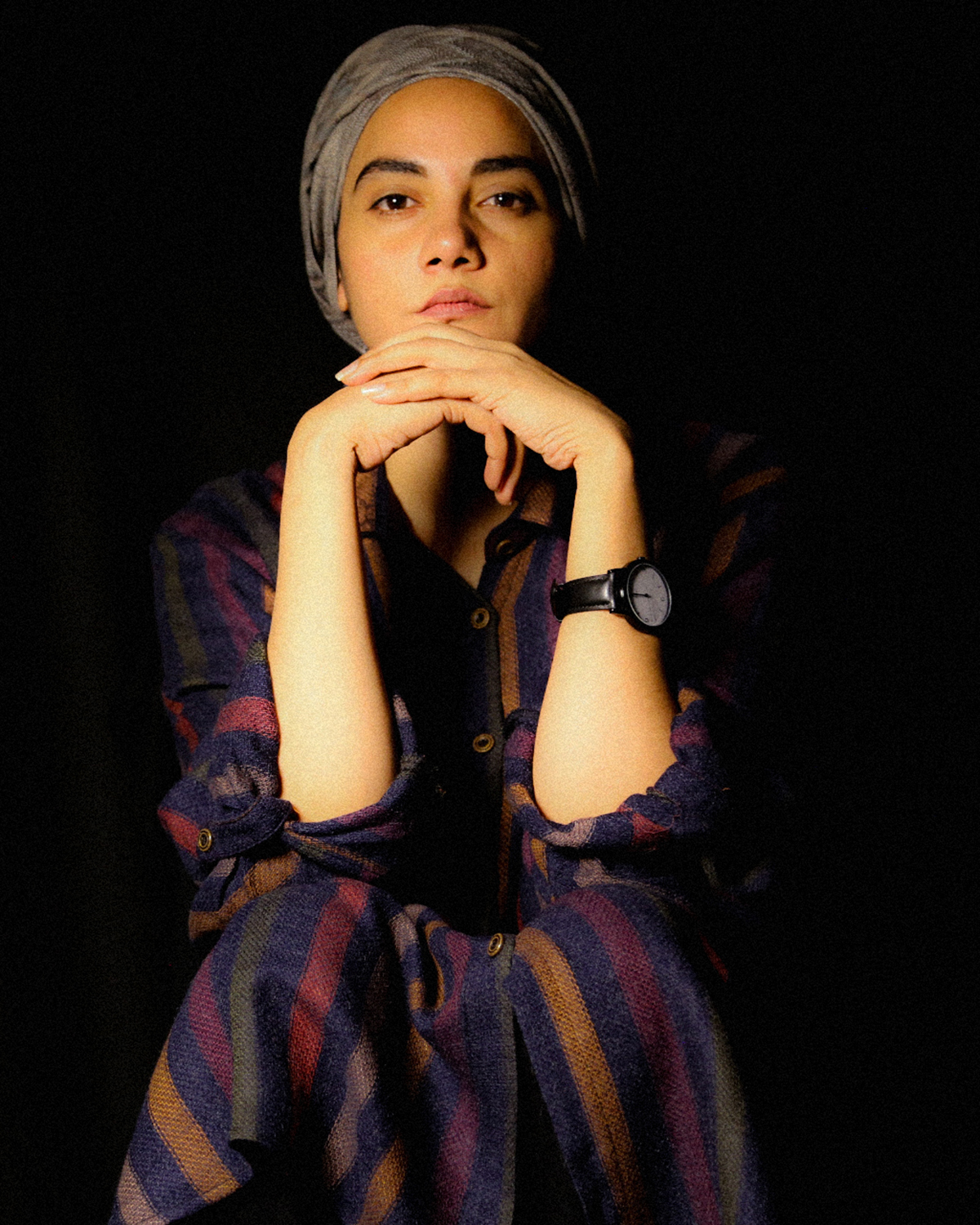
Arshi Irshad Ahmadzai, now based in Germany, is greatly influenced by Rabindranath Tagore, her professor, Wasim Mushtaq and most particularly, Zarina Hashmi — the resemblance is hard to miss after you make that note. Image courtesy of Nashenaas
While Arshi is considered an established voice capturing the reality of Muslim women in India, her work is better understood through the multiple rhythms that run parallel to one another; contesting an overt significance in each work. The state of women’s agency, the prevalence of caste across religions, and existential contemplations — all appear with shifting importance.
Her early recognition came with the collaborative artwork Lihaf (2020) where she invited several Muslim and Dalit women from her hometown, Najibabad in Uttar Pradesh, to come and stitch a quilt together. “The society I’m coming from heavily controls the female body,” she stresses. With Lihaf, Arshi managed to gather the feelings she, and the women around her felt and seldom had the opportunity to express. She recalls their conversations: Discussing Urdu poetry, singing bhajans, and wondering what it even means to be a woman.
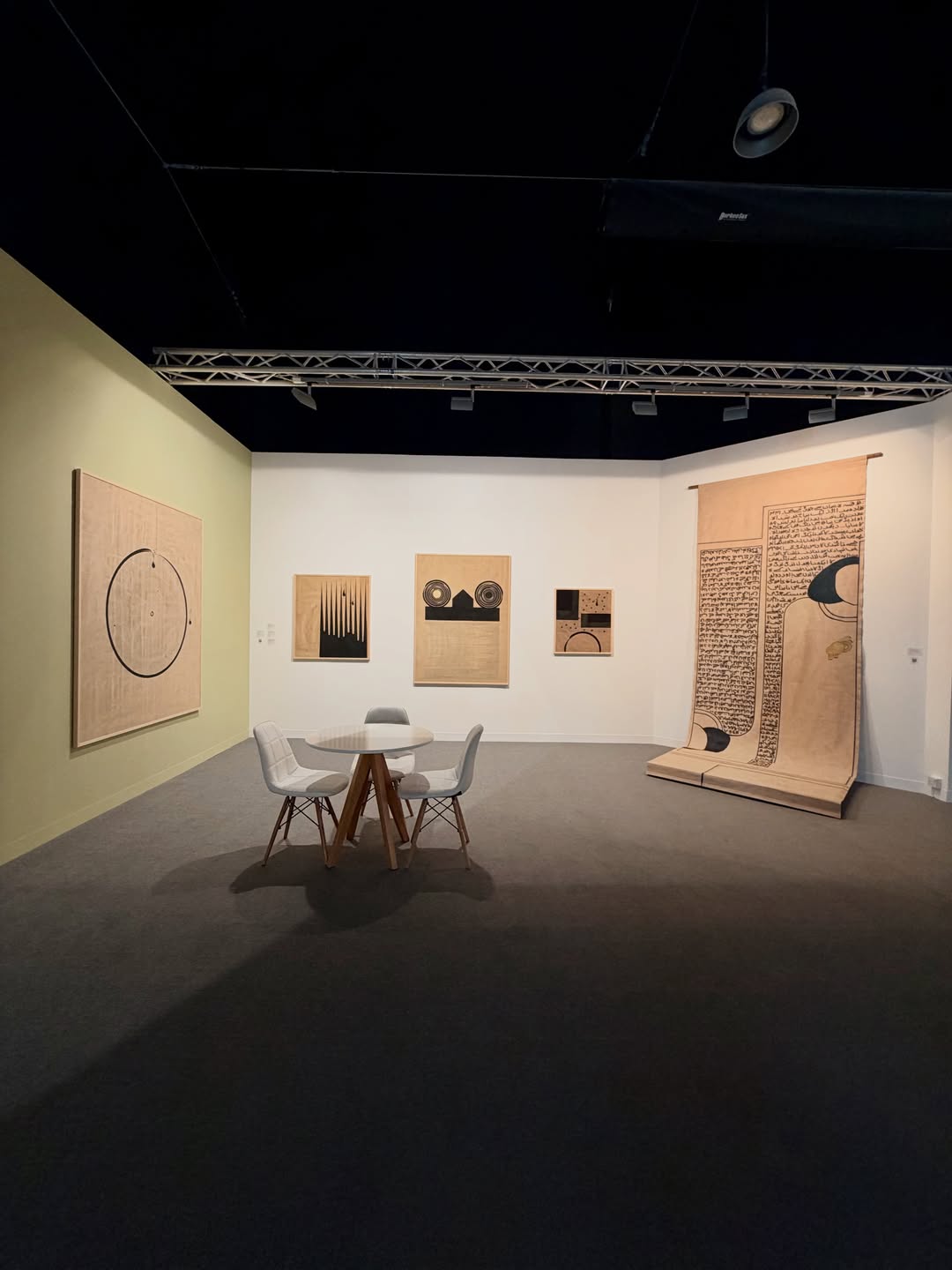
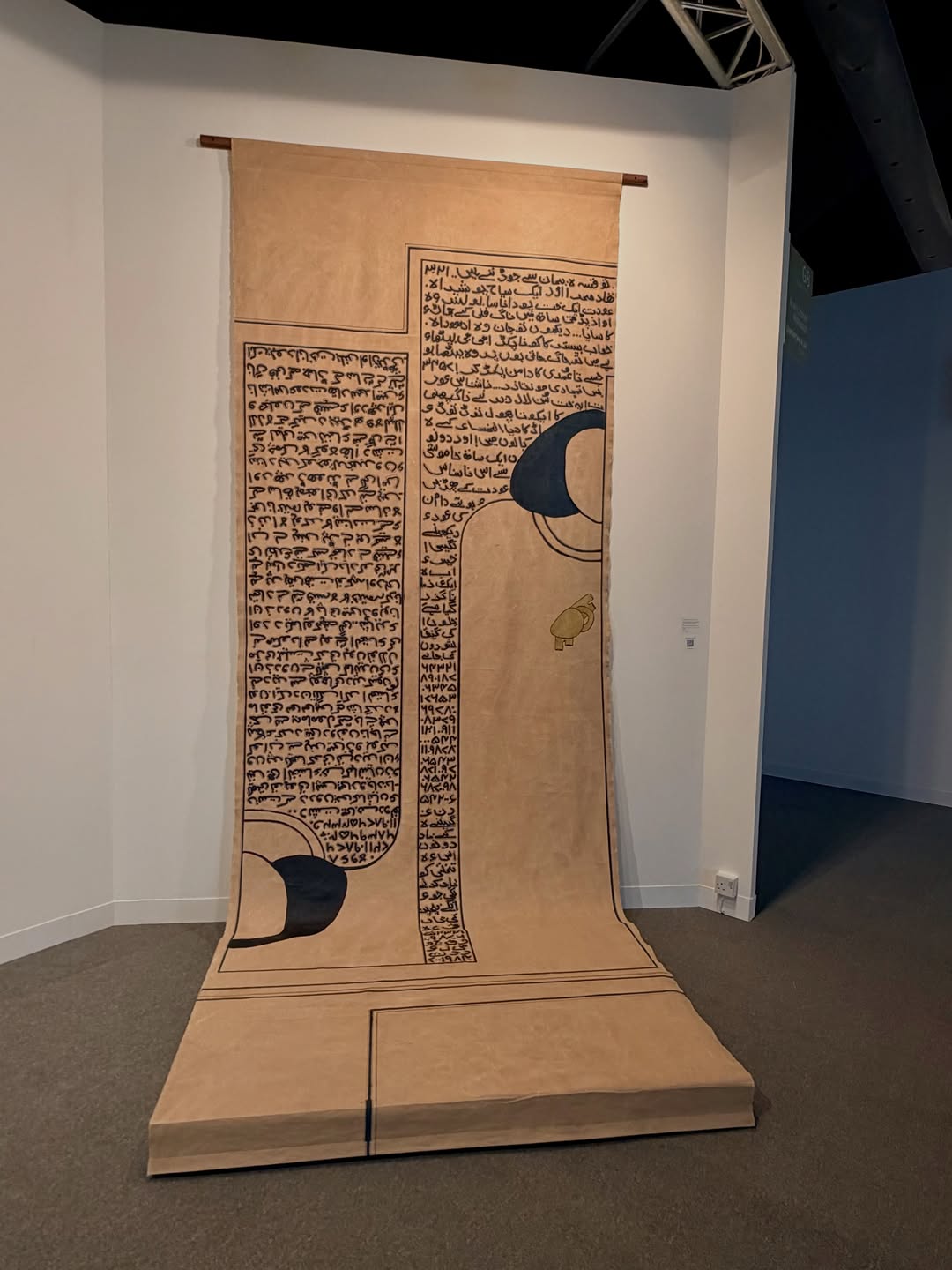
(L-R) Chatterjee and Lal’s presentation of Arshi’s work at Frieze Abu Dhabi Global Futures, curated by Tarini Malik; the artwork, Dasht-e- Leili wa tanha gul-e- Lalah
Her next prominent series came in the wake of the lockdown when she found herself separated from her husband who was stuck in Kabul, while she remained in India. In response, Arshi penned 128 letters pressed onto cloth that eventually became Nafas: The Isolation Diaries (2021), a series that depicts a deep yearning and desire. This collection was followed by Qissah-e-Kabul (2022), a series grounded in grim realities that she and her family faced as they fled Afghanistan in 2021. “I had to destroy a lot of my artworks just out of fear of what might happen,” she recalls. It is the very fear that Arshi talks about, one that gripped the rest of Kabul, that tore into the artworks she was able to carry back to India. The works are physical evidence of impending violence and political chaos.
Movement, intended or coerced, is central to understanding the thematic and material basis of Arshi’s practice. Favouring manjarpatta, papier-mâché, and Manetti gold, she creates artworks that are suited to her travel cycles. “I discovered Manjarpatta when I was in Mumbai around 2019. Since then, I’ve adopted the material fully because it matches my life. I can fold up my work and take them anywhere with me in the world,” she shares.
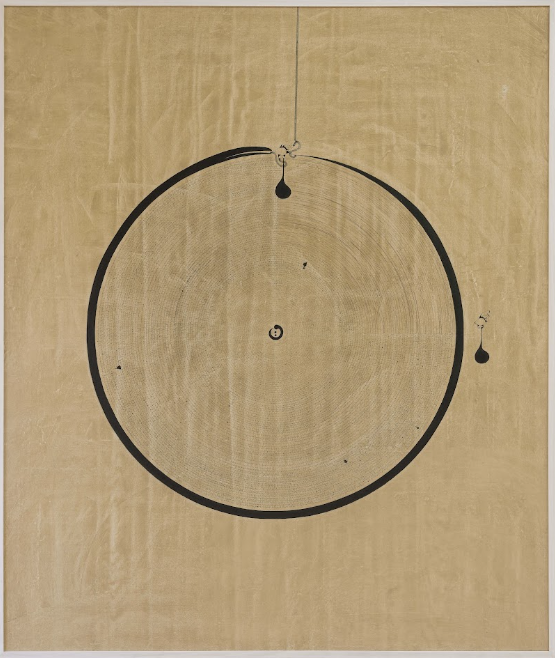
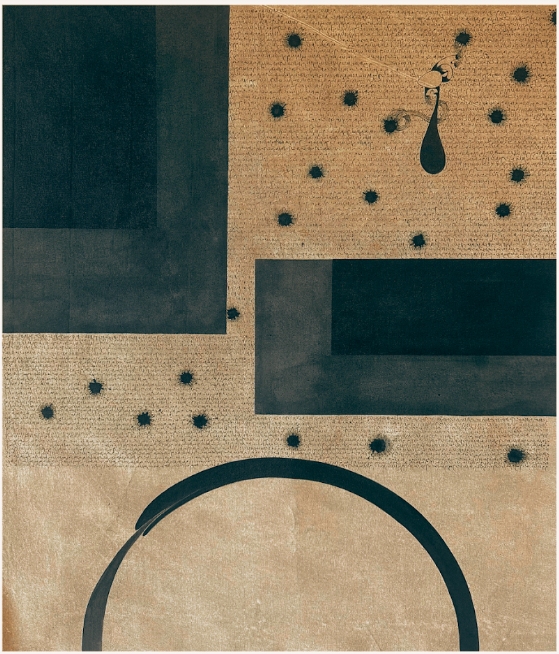
(L-R) Azal-o Abad aur ek beech ka lamha (A moment suspended between the two eternities), 2025; Ek qissah-goh dil ne adhoori abdiyat ke kaano mein phusphusaya… Wou bhi khuda se kam na tha jisne hamein khuda diya (A storyteller-heart whispered to an unfinished eternity… The giver of God was himself no less divine), 2025
What becomes evident in Arshi’s work is that she is a poet in her own right. Instead of relying on either one of her talents, she’s managed to cultivate a signature that is an impressive mix of both. “If you want to understand my works, you need to read the title first,” she says. That is what one relies on as the visible poetry transfers from the canvas to the label next to it, since the artist strives for abstract layouts. Her last exhibition, Azal Se Abad Tak: a Journey Between Two Eternities at Chatterjee and Lal is a step away from her earlier compositions, relying solely on recurring motifs like the ouroboros to make sense of an existence away from India, where her childhood home is, and also from Kabul, where she built her family a new abode.
From stories within stories, we cull out an image of Arshi’s life — an artist who has felt and imbibed the distinct realities of being a woman, and being a Muslim in a volatile world. It is in her work that we discover the many lives of poets, mystics, and artists of the region. It is not lost on us that she is every bit an elusive artist in her own right.
Words by Tanya Syed
Featured image: Arshi Irshad Ahmadzai, Jab Ishq-e Majazi Ishq-e Haqeeqi kou nighal Aftaab ho baitha (When the finite passion swallowed the infinite, and rose blazing like the Sun), 2025. Courtesy of the artist and Chatterjee & Lal