In 2009, American writer Maggie Nelson published her genre-defying work Bluets, a book-length lyrical prose where the author picked up the colour blue and explored the themes of love, loss, and grief. For Nelson, blue isn’t just a colour but a meditation on life itself; it became a way through which she wrestled with her own thoughts and quickly found herself unravelling all aspects of the colour. She writes, “I must admit that not all blues thrill me. I am not overly interested in the matte stone of turquoise, for example, and a tepid, faded indigo usually leaves me cold. Sometimes I worry that if I am not moved by a blue thing, I may be completely despaired, or dead. At times, I fake my enthusiasm. At others, I fear I am incapable of communicating the depth of it.”
A colour once found in the remote regions of Afghanistan in the form of lapis, crushed carefully to paint the images of the Virgin Mary, and used in the burial rituals of ancient Egypt, now exists as a metaphor for our lives — our collective sighs on Monday blues and representing a feeling we cannot exactly pinpoint. In the depths of the colour blue, we find comfort with the uncertainty of our lives. What Nelson explored with her work through words is picked up by an artist to create a world where blue is a norm of human life.
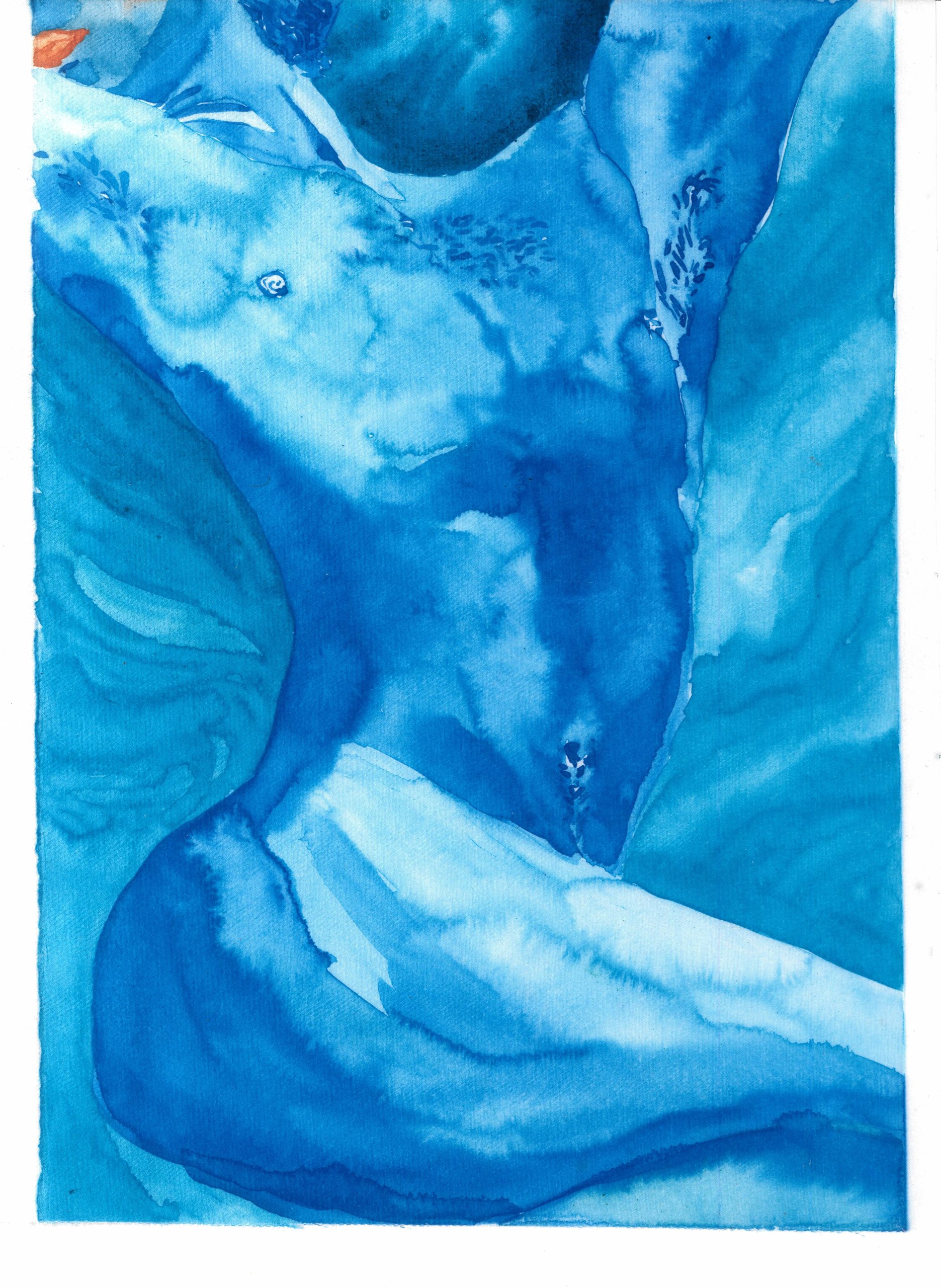
Bluets is what Shakil Solanki, a visual artist from Cape Town, calls his “Studio Bible”. Growing up as a third-generation Indian didn’t keep him away from his heritage. “I grew up reading Amar Chitra Katha comics and was obsessed with the mythologies and the visual language of it all — the jewellery, the clothes, and enchanted by the characters,” shares Solanki. The influences are visible — the 29-year-old paints queer bodies with blue in an attempt to equate them and their existence to something divine.
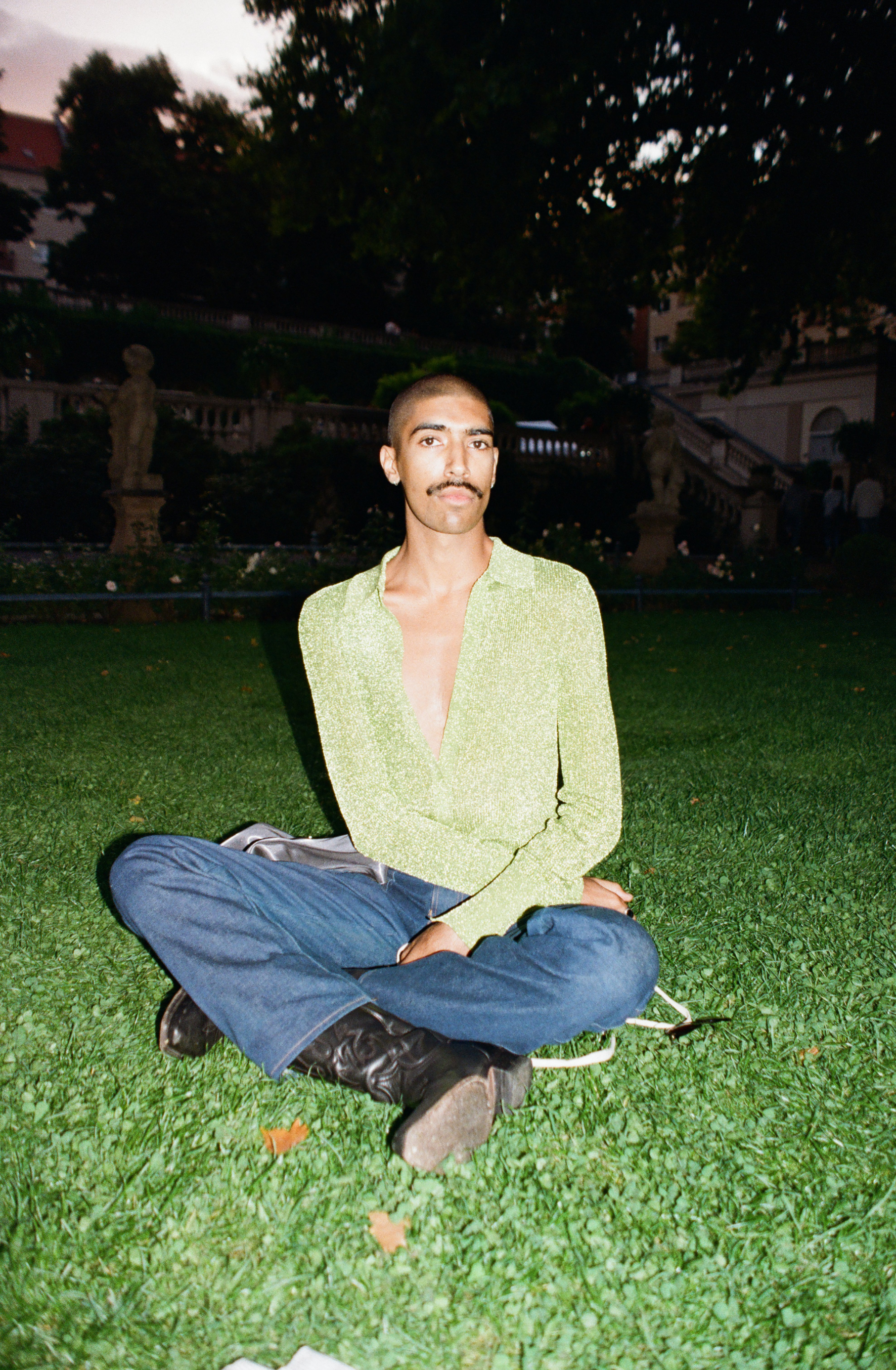
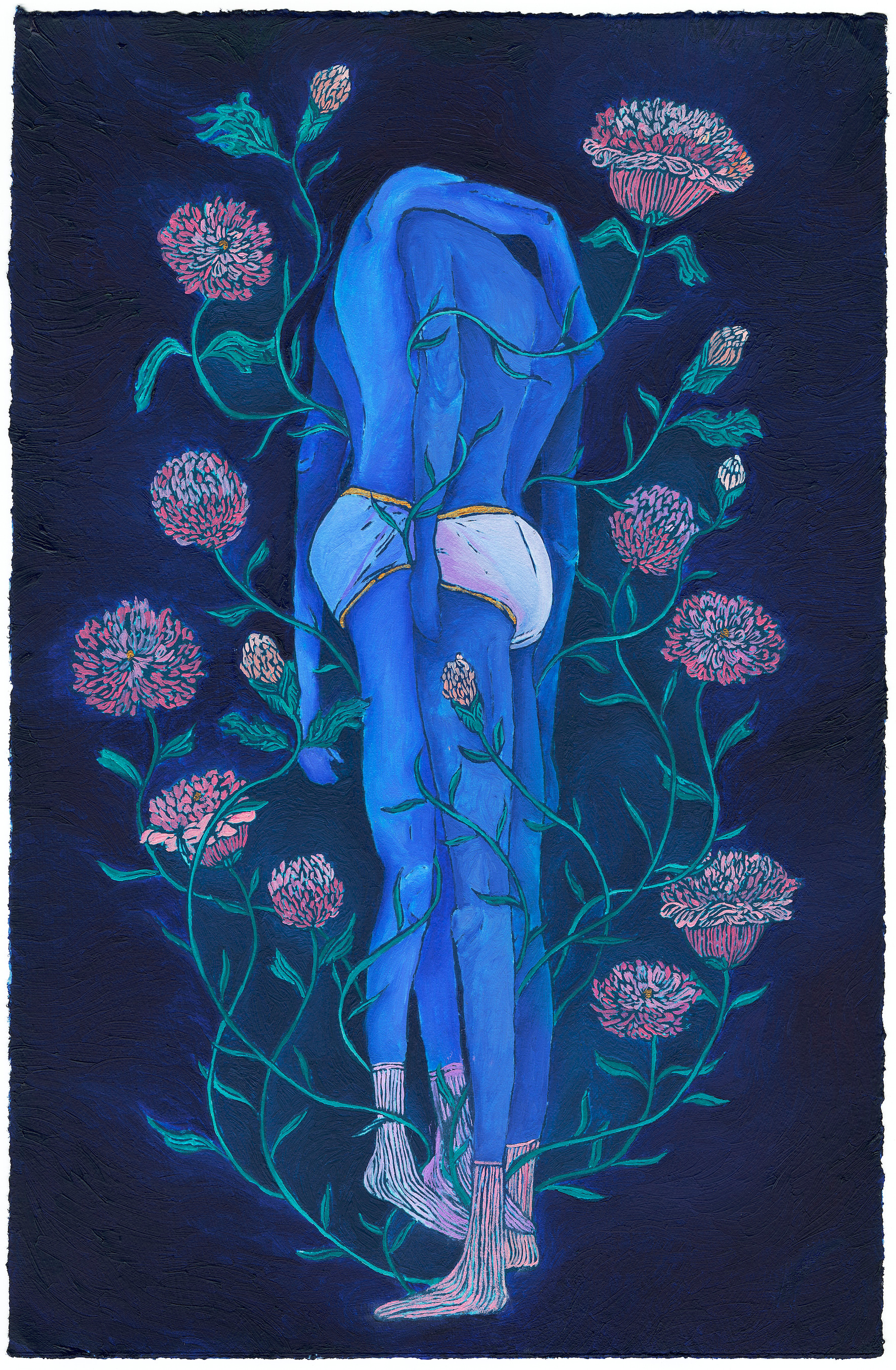
(L-R) Cape Town artist Shakil Solanki imagines queer life with blue hues; His work You are afraid it may change you (2022), contextualises queer existence in our times
In Hindu mythology, the sustainer of the universe is depicted with blue skin, and so is the fierce form of the mother goddess, representing the limitless nature of the cosmic consciousness. It was only natural for him to pick up a colour that made queerness a part of the larger world we inhabit, something as celestial as the blues of the sky and the sea. Between the two blues exists the third, one under the skin of our human bodies where our nerves run blue.
In the work You are afraid it may change you, two men stand together, bodies almost dissolved into one, wrapped around with flowers. The blue of their bodies stands against the contrast of the one behind them, almost representing the eerie nature of time. While the bare bodies stand together, merged into one, the flowers bloom around them — suggesting the hope for life in a world where queerness exists as the “other”. Four men are holding traditional lehenga cholis in The queers prepare for Baraat — their bodies are blue, but the clothes they hold and wear are bright. They reflect the overlooked, queer nature of the wedding markets of India. These are the same shops where men drape sarees and hold bridal skirts to sell them to brides. There is a melancholy attached to it, a hope for a world where queer men get to play around with clothes more freely.
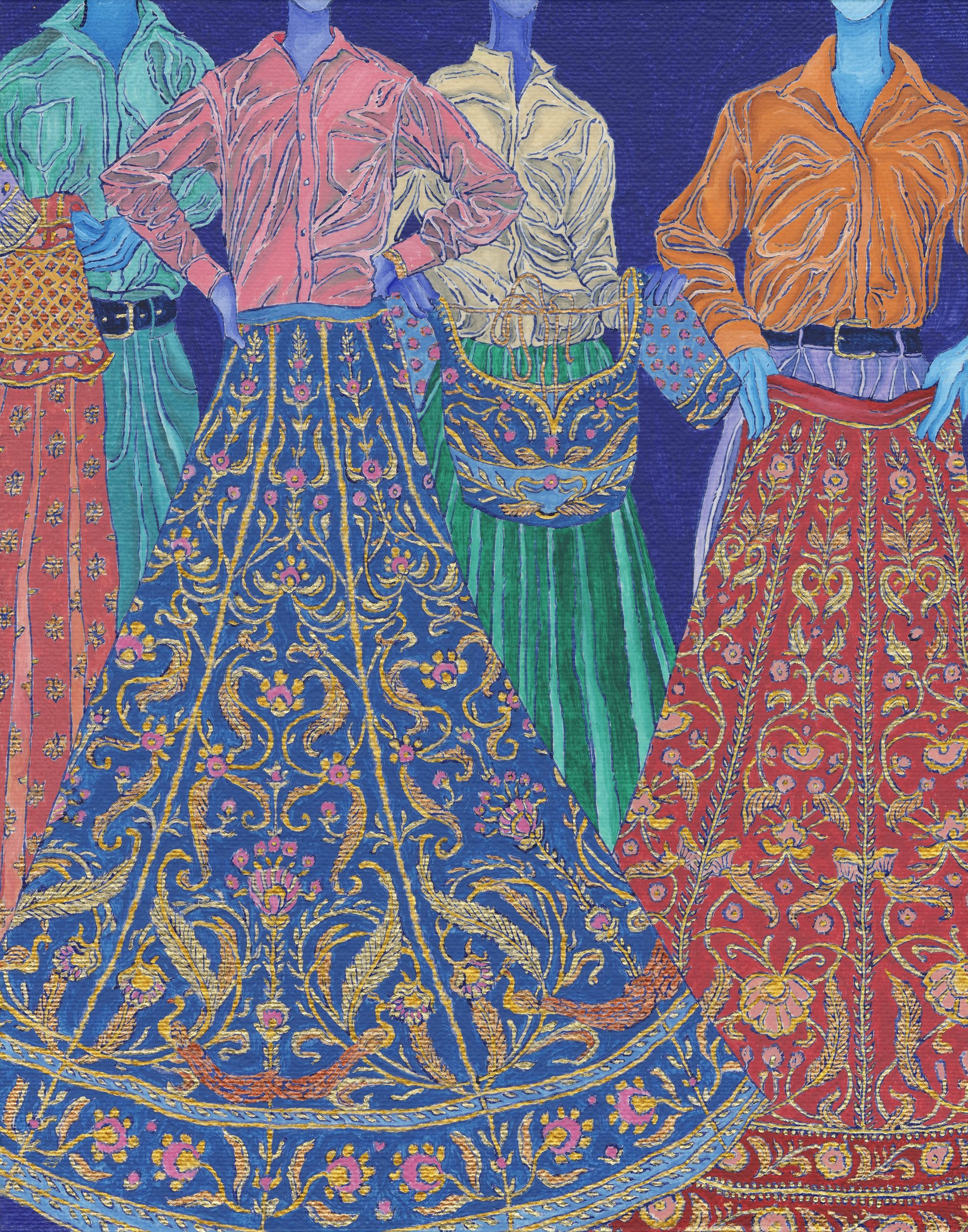
The queens prepare for the baraat (2022)
While the former two put a more contemporary lens to queer desire, A sumptuous palace opens itself to our gaze, our rapid flight carries us off the heavens illustrates Solanki’s inspiration from Indian history the best: Three figures stand together adorned in gold jewellery, representing the fluid nature of sexuality, and queer desire. The gestures of holding flowers and objects mirror the Mughal miniature portraits. The multiple hues of blue play a playful dance, and come together to create a visual which directly makes a statement — we have always been here.
“The understanding of my culture is quite… fragmented. What we see of India online is very different from what I remember when I last visited. A lot of it is tainted by memory, but the internet culture helps to keep an eye on what’s new,” Solanki shares. The artist finds inspiration in ancient temple carvings, miniature paintings, Bollywood in the 90s, Darek Jarmen’s 1993 film Blue, Rebecca Solnit’s writing and her idea of blue being a colour of distance, and Roland Barthes’s A Lover’s Discourse.
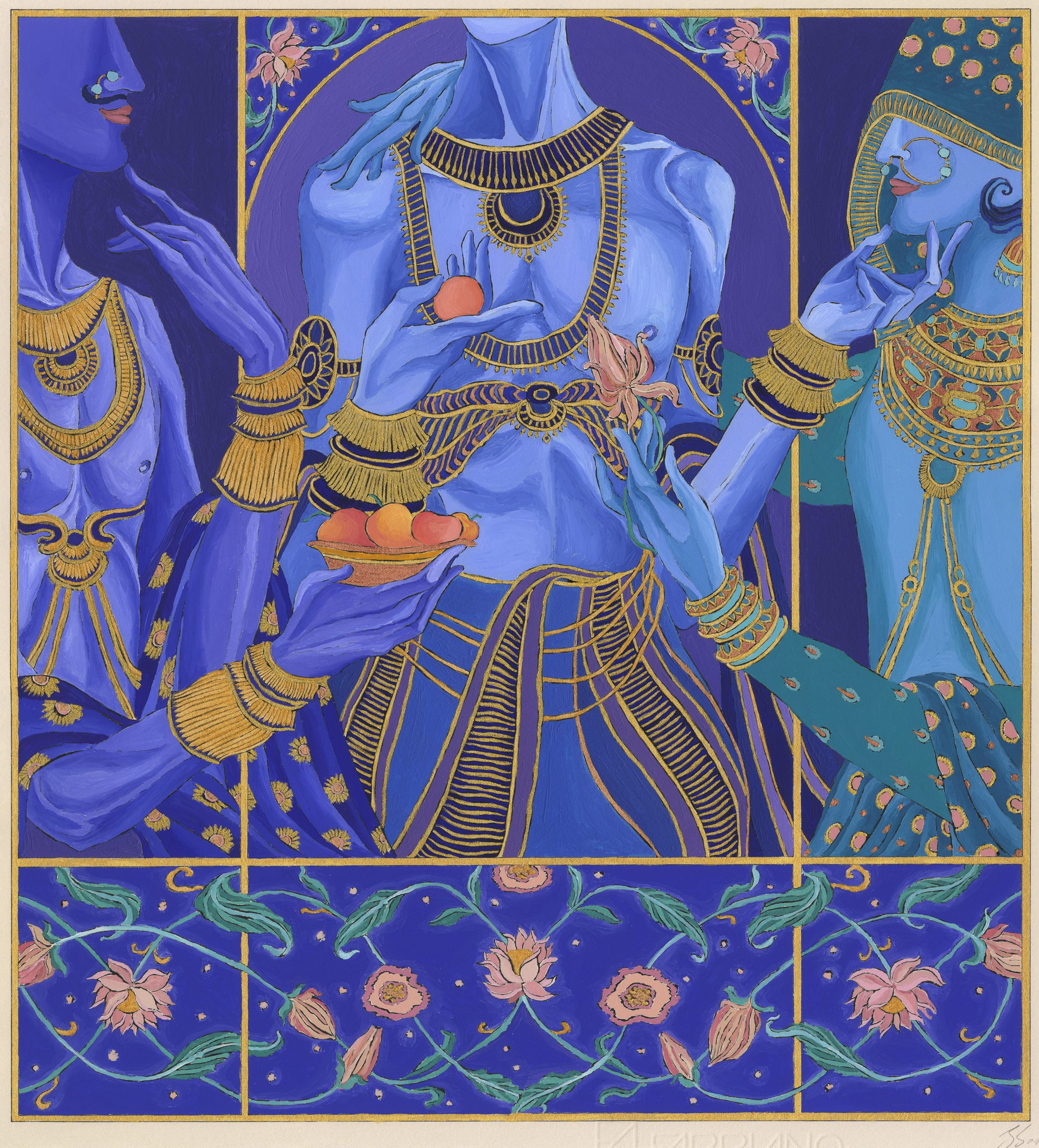
A sumptuous palace opens itself to our gaze, Our rapid flight carries us off to the heavens (2023)
Solanki studied printmaking in Cape Town and is now doing an MA in textiles at the London College of Fashion. The transition to textiles has been challenging — there is a change of medium, of course, but to represent the experience of a “queer diaspora” has been challenging too. He looks forward to expanding his work to both the arts and fashion world, where he can use his textile skills to create more dynamic works on a larger scale.
“I enjoy the duality of the colour — it is melancholic but is also seductive. The two go hand in hand for me,” he shares. Solanki now wants to incorporate reds and colours that strengthen his blue. Solanki finds power and depth in blue that he fails to find in any other colour and keeps going back to it with the same enthusiasm as he first did in his undergrad.
Solanki’s use of blue isn’t just an artistic choice but rather a meditation on the colour itself — blue becomes a colour where life and death converge, the start and end of the universe, and a home to our overwhelming feelings of longing and emotional depth.
Or as Maggie Nelson writes, “… is to be in love with blue, then, to be in love with a disturbance? And what kind of madness is it anyway, to be in love with something constitutionally incapable of loving you back?”
Words by Harsh Aditya
Feature image: Why I always dream of you (2026) by Shakil Solanki